

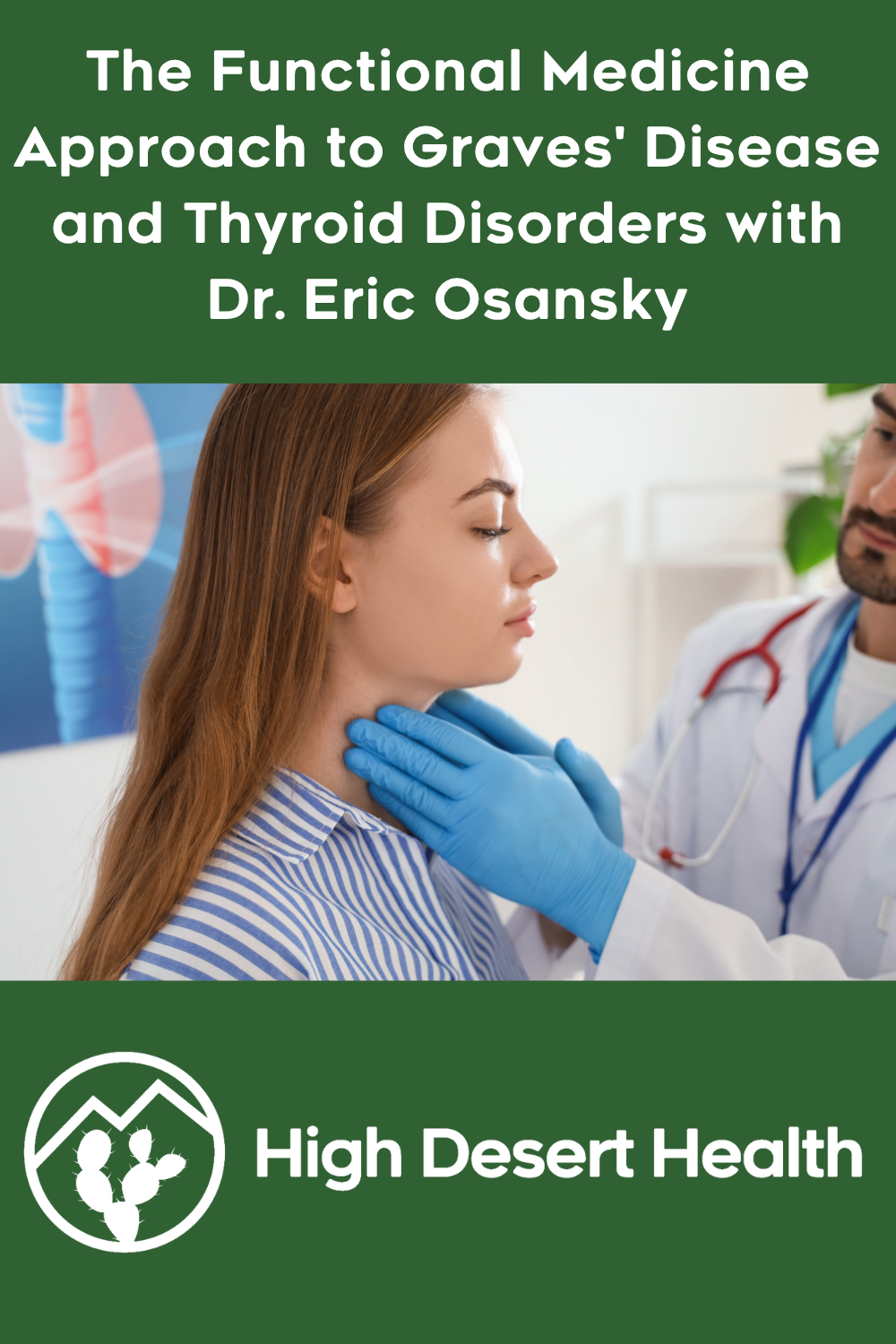
Adapted from episode 171 of The Perfect Stool podcast and edited for readability with Eric Osansky, DC, MS, IFMCP and Lindsey Parsons, EdD.
Lindsey:
So, can you tell me about your own health story and how it’s shaped your practice?
Eric Osansky:
Yeah, so I was diagnosed with hyperthyroidism and eventually Graves’ disease, and it’s usually a shocker to everyone and to me as well, just as I was in the process of trying to lose weight. I was a little bit overweight, maybe like 10,12 pounds, normally I’m 170 and I was 182 and so I was dieting, detoxifying, exercising intensely, too intensely, but was losing weight. And little did I know that some of the weight loss, I’m sure, was due to what I was trying to lose, as far as the exercising and the dieting, but some of it was as well related to the hyperthyroidism.
And I didn’t catch on until I was walking in a retail store, and I took my blood pressure at one of those automated blood pressure machines, and my blood pressure was normal, but my resting heart rate was a little bit high, and I figured, because I wasn’t fully resting, I was walking around, so I took my heart rate manually the next few days, and it was anywhere between 90 and 110 beats per minute, and so I figured something was up. Went to a regular doctor, got a few blood tests, was diagnosed with hyperthyroidism, and then eventually saw an endocrinologist, got the Graves’ disease diagnosis.
And at the time I really didn’t know much about Graves’. My background is as a chiropractor. I didn’t know about Graves’, but as part of my continuing education credits, I would always attend nutrition and functional medicine seminars, and I did coincidentally attend a few functional endocrinology seminars where they focus more on hypothyroidism and Hashimoto’s, just because that’s a lot more common, but they spoke a little bit about hyperthyroidism and how there are natural symptom management options. And there are with anything, there’s a cause behind it, so I decided that when I was diagnosed I was going to at least attempt the natural approach.
I had no idea if it would work. I tried to be optimistic, but when you don’t know anybody else who dealt with the same condition that you’re dealing with, you’re a little bit skeptical. But thankfully, what I did worked over time. I was able to normalize my thyroid hormones, my antibodies, the thyroid stimulating immunoglobulins, which are specific for Graves’, and then I just realized that there are so many others with thyroid and autoimmune thyroid conditions, and so I started. This was back in 2009 when I started working with others with these conditions, and just over the years I’ve been known more for hyperthyroidism and Graves’, just because of my experience, and then also there’s just not a lot of practitioners that focus on hyperthyroidism and Graves’, as most focus more on again hypothyroidism and Hashimoto’s, just because it’s the much more common condition.
Lindsey:
Yeah, why don’t you elaborate as to the difference between those two conditions?
Eric Osansky:
Sure, I could start by talking about the difference between hypo and hyper, and then talk about Hashimoto’s and Graves’. So you have thyroid hormones, the main thyroid hormone that’s produced by the thyroid gland, which is the butterfly-shaped gland in the middle of the neck, and it produces mostly T4 a little bit of T3 but T4 converts into T3, which is the active form of thyroid hormone, and that binds to the receptors. And there’s also T1, T2; we’re still learning about those, and you still can’t test for those at a regular lab, but with hypothyroidism, you have those thyroid hormones on the lower side, and then with hyperthyroidism, it’s the opposite, you have too much thyroid hormone. And then there’s a pituitary hormone called thyroid stimulating hormone, or TSH, and so TSH communicates with the thyroid gland, and so when you have low amounts of thyroid hormone, there’s more TSH, just telling the thyroid gland we need more thyroid hormone, so as a result, with hypothyroidism, with low thyroid hormone, you usually have higher TSH, and again that’s in response to the lower thyroid hormone.
What is hyperthyroidism? Since you have too much thyroid hormone, the pituitary gland is trying to communicate to the thyroid gland: let’s slow things down, there’s too much thyroid hormone, so there’s low TSH, often times depressed TSH. So with hyperthyroidism, you have elevated T4, T3, low or depressed TSH, and then hypothyroidism, you have low T3, T4 and many times it’s subclinically low, which means it might be within the lab range, but on the lower side, so it’s not overtly low, it’s not outside of the range. Unfortunately, many doctors will ignore it because it’s within the lab range, even though it’s not optimal. But again, hypo-low thyroid hormones, elevated TSH, and then most thyroid conditions are autoimmune, so most hypothyroid conditions are related to Hashimoto’s.
And Hashimoto’s is when the immune system attacks the thyroid gland, and that’s over time what causes the low thyroid hormone, whereas with Graves’, Graves’ involves the immune system attacking the TSH receptors of the thyroid, which stimulates the thyroid to produce more thyroid hormone, and there’s different antibodies, I mentioned the antibodies that came back positive for me were thyroid stimulating immunoglobulins, which are specific for Graves’, and then there’s thyroid peroxidase antibodies, or TPO antibodies, which are more common in Hashimoto’s, but actually a lot of people with Graves’ have them as well. I was negative for those, but I do see them in a lot patients with Graves’ and Hashimoto’s, and then thyroglobulin antibodies. Those are more specific to Hashimoto’s. Those are the three main types of antibodies, and so essentially that’s the difference between the two conditions.
And the problem with conventional medicine is that they do absolutely nothing for the immune system, as you know, they focus on the thyroid, so if you have low thyroid, if you have Hashimoto’s, usually they’ll recommend thyroid hormone replacement, like levothyroxine, and then with hyperthyroidism, they’ll recommend either medication, such as methimazole or PTU, or radioactive iodine, thyroid surgery, in some cases. And again, there’s a time and place for conventional medicine, there’s time and place for thyroid hormone, a time and place for antithyroid medication, even a time and place for thyroid surgery, but that’s all they like when it comes to medication. Again, they do absolutely nothing for the underlying cause that is the problem, which again, that’s why people are listening to this and watching this, because they want to know what to do. They don’t want to just take the medication again, maybe you have to take it along with addressing a causative problem, but if that’s the only thing you’re doing, then you’re setting the stage, potentially, for developing other autoimmune conditions in the future.
Lindsey:
Yeah, I’ve also seen on blood tests sometimes just in a measurement of thyroglobulin, period. What’s that about?
Eric Osansky:
Yeah, so thyroglobulin, so that’s a protein of the thyroid gland. So, when you have thyroglobulin antibodies, that means the immune system is actually attacking and damaging thyroglobulin, and you could test thyroglobulin separately. I can’t say I do it on a regular basis. If someone has thyroid cancer, and then they get the thyroid gland removed, then they’ll look, and they’ll test thyroglobulin, just because that should be low or pretty much non-existent, because there’s no thyroid gland. On the other hand, if someone has a thyroid gland, and if they test thyroglobulin, and if it’s elevated, it could mean a few things. Sometimes it’s just elevated because you have those thyroglobulin antibodies. There is some evidence that it could be related to an iodine deficiency. I don’t know if I would rely on that for that. There are some published journal articles showing that when it’s really high, it could be an indication of cancer. Most of the time, it’s not. I’ve seen some high readings, at least when I look at it, when again, it’s usually not cancer, but there’s always a risk. Again, if you have those thyroglobulin and antibodies, it’s not uncommon to also have that thyroglobulin marker elevated as well.
Lindsey:
Yeah, that’s why I’ve seen it, because my sister had thyroid cancer and had her thyroid removed, and I looked at her blood test; that’s why her doctor ordered those. Yeah, do you have a an optimal reference range for TSH that you like to follow?
Eric Osansky:
I like to see between one and 1.5, everybody’s different, so if it’s between one and two, that’s fine. If it’s a little bit below one, I get a little bit nervous just because I see a lot of people with hyperthyroidism, but if someone has 0.8, I don’t panic. Yeah, I would say like a sweet spot is one between one and 1.5 but again, if someone has a TSH of 1.8 and everything else looks good, like their T3, T4 within the optimal ranges. Obviously you can’t just rely on symptoms alone, but if they’re feeling good, the other tests are within optimal ranges, I wouldn’t recommend intervention necessarily, just because the TSH is a little bit above what I consider the optimal range.
Some functional medicine practitioners consider an optimal range between one and three, so if someone’s a 2.5 they would consider that to be fine. Most natural healthcare practitioners usually, when it gets above three, there’s the consensus it’s an issue, and the problem is that most labs, their reference range goes up to 4.5 or five, so someone could have a TSH of 4.3 and that usually is indicating a problem, but because the lab says that it’s not a problem, they usually just say keep an eye on it, they might not, if it’s just part of a physical, they might not say to keep an eye on it, just do the next physical, and so that would be what I consider the optimal range of TSH.
Lindsey:
Yeah, so what symptoms are coming with Graves’ disease, and how do they differ from Hashimoto’s?
Eric Osansky:
Yeah, so I could share some of my symptoms. When I dealt with Graves’, I experienced that increased resting heart rate, the tachycardia, which is a pretty common, a pretty classic symptom. I also had heart palpitations, I didn’t have anxiety, but anxiety is pretty common. Insomnia is common. I did experience a lot of weight loss. I mentioned how I was trying to lose weight, and I was at 182 and I ended up at 140, which is definitely a lot lower than was, I’m sure, due to my weight loss efforts, but again, a good amount of the weight loss, I’m sure, was due to the hyperthyroidism as well. Weight loss is common. Think of it, it speeds up everything. The heart rate increased, the palpitations and anxiety, increased bowel movements. So, frequency of bowel movements, sometimes loose stools, diarrhea, heat intolerance.
Whereas with hypothyroidism, you get things slowing down, you get fatigue, you get brain fog, you get constipation, and commonly instead of heat intolerance, you get coldness. Hair loss is common with both hyper and hypo, depression, probably more common with hypothyroidism, not that people can’t be anxious. And that’s the thing, sometimes you get conflicting symptoms; there are people with hyperthyroidism who don’t lose weight, who have the opposite problem for numerous reasons, and they might have issues losing weight or actually be gaining weight, and that’s even more frustrating because most people, doesn’t matter if it’s women or men, but because you know men, a lot of men, like myself, trying to lose weight, it gets frustrating.
Some people, when they lose weight with hyperthyroidism, that’s like the silver lining. It’s like, oh, it’s a bummer to have Graves’ and hyperthyroidism, but at least I lost 15 to 20 pounds. Whereas someone who was looking to lose weight, and then they are gaining weight, or they can’t lose weight, and they see that one of the classic symptoms is weight loss, and with hyperthyroidism, everything is in the classic situation sped up, and then with hypothyroidism everything is slowed down, but sometimes you do get that overlap of symptoms.
One other thing I should mention that’s common with Graves’ specifically, not necessarily hyperthyroidism, there’s a condition called thyroid eye disease, and that’s when the immune system attacks the tissues of the eyes, and in some cases of Graves’, approximately 50%, even though most cases are very mild, but some cases it’s noticeable, where you see the eye bulging. The person could experience double vision, swelling of the eyes. In severe cases, it could compress the optic nerve. Again, most cases are more on the mild side, but every now and then, I’ll work with someone, and that was their first symptom, they had eye symptoms, and didn’t know what was going on, and they went to an ophthalmologist, maybe first an optometrist, and then eventually an ophthalmologist, and got diagnosed with Graves’ that way, and not through an endocrinologist, which is how most people are diagnosed with Graves’.
Lindsey:
Yeah, okay. So, what causes Graves’ disease, and how does it relate to gut health?
Eric Osansky:
Yeah, great question. In Graves’, as well as other autoimmune conditions, you have what’s called a triad of autoimmunity, also known as a three-legged stool of autoimmunity. There is a genetic component, and you can’t change the genes, you could change expression of genes. But the good news, you could change the other two factors, which is being exposed to one or more environmental triggers, and the third component is that increase in intestinal permeability, which is also known as the leaky gut, and so if you’re exposed to triggers, it could be certain foods, such as gluten, stress could be a trigger, both emotional, physical stressors. I was also, I mentioned, I was exercising intensely, I was over training, so it was in my case. Stress was definitely a factor, but it wasn’t just emotional stress, it was too much exercise. Infections like viruses, speaking of the gut bacteria, like H. pylori, there’s a correlation between H. pylori and Graves’, as well as with Hashimoto’s toxins and toxicants, where, of course, you live in a toxic world. And then again, you have that leaky gut component as well, so the gut plays a role in a few different ways, you get that leaky gut that can make someone more susceptible, and then most of the immune system cells are located in the gut, so just by that alone you need a healthy gut to have a healthy immune system. And then I mentioned certain infections, things like H. pylori, parasites, can set the stage, or at least be contributing factors, when it comes to a development of Graves’.
Lindsey:
Is there a specific diet you recommend to people with Graves’ disease?
Eric Osansky:
Yeah, yes, and no. I wrote in one of my books, The Hyperthyroid Healing Diet, a little bit misleading, because when you hear that, you might think that there’s a single diet, but I actually talk about three different diets. And even with those diets, there are variations, but there’s what’s what I refer to as a level three, level two, and level one diet. The level three is the most restrictive, it’s an autoimmune type diet, like a modified AIP diet, and that’s usually what I recommend for people to start with, and then follow that. It’s like an elimination diet. The way I look at it, it’s not a permanent diet, it’s a starting point, an elimination type diet, and eventually they’ll reintroduce foods, but then a level two is kind of like a modified paleo, so if someone just is not ready to follow a level three, then they could follow a level two, again modified paleo, and then level one is the least strict of the diets. If you’re familiar with Dr. Stephen Gundry’s Plant Paradox diet, it’s a modification of that, though it does allow some properly cooked legumes, beans, lentils, minimal grains, so there’s more flexibility. So if someone’s a vegan, they might choose to follow the level one diet, but, really, we both know there’s no single diet that fits everyone. What we all have in common as practitioners is at least more on the natural side, maybe not conventional, but even conventional, you would hope that they recommend whole, healthy foods, avoiding the refined foods and sugars. And then, of course, common allergens like gluten, dairy, at least while healing, especially gluten, essentially it’s an autoimmune type diet, is what I recommend, but it really depends on the person.
Lindsey:
Yeah, that’s one of the things that I sort of object to in the Gundry stuff about excluding the beans and lentils, because as somebody who looks at gut health reports all the time, low fiber and low butyrate producers, that’s one of the things I see most commonly on people’s gut reports, stool tests, and so if you take out beans and lentils, which are the powerhouses of providing fiber, then it’s really hard to get enough fiber. And it’s hard to get enough protein if you’re a vegan or a vegetarian.
Eric Osansky:
Yeah, I agree. Even with AIP, more recently I’ve questioned, just because the benefits that legumes have to the gut microbiome, and I know they’re not part of AIP and they’re not part of paleo for the same reason, just because of lectins and the compounds. But then if you’re properly preparing them or pressure cooking them, at the very least it greatly reduces those, and I’ve also thought about, is it absolutely necessary for people to do. People do heal on AIP and paleo, but it is more challenging to get in the fiber-rich foods that way, and legumes also are a good source of protein.
Lindsey:
Yeah, I used to eat very few until I got a report with high beta glucuronidase, and I knew I needed to cut down on my meat and my fat and eat some more plant-based proteins. So I just went out and I bought several bags of hard beans and started soaking them overnight and putting them in my Insta pot, and all of a sudden it became easy. What seemed like this big obstacle to eating them, it was like, oh no, if I just soak them at night, then the next day I’ve got a solution, I’ve got something for dinner. And for me personally, they definitely help.
Eric Osansky:
Quick question with that, do you still need to soak them if you put them in a partial cooker, though?
Lindsey:
I soak and rinse them too. I think that gets rid of some of the lectins.
Have you found that mycotoxins play a role with Graves’?
Eric Osansky:
In some cases, yeah, definitely becoming more and more aware of the impact of mold and mycotoxins. And 10 years ago I didn’t recommend urinary mycotoxins testing. Now, of course, it’s a lot more common. There are more labs that offer that, which makes it easier, but yeah, that falls in the environmental toxin category. And unfortunately, as you’re aware of, I’m sure it’s a problem that is overlooked, because if someone just doesn’t see a leak, or any signs of water damage, assume that molds aren’t an issue, even though it could hide behind walls, underneath the floor, and then it could colonize the gut as well. Yeah, that could definitely be a potential trigger, and/or impact gut healing as well, if it is colonizing the gut.
Lindsey:
I’ve been testing it more and more, and unfortunately finding so many people with mycotoxins, and even people who are like, oh it’s a new house, it’s only six years old, and we just moved in. But it’s in Florida, and did it rain while they were making your house, and then suddenly the mold spores are already in there? A new house is no guarantee, and I hate to deliver that news, because it’s a super huge expense, so all I can say is, before you buy a house, before you rent a house, just pay for a mold test, because you’ll save yourself such a nightmare.
Eric Osansky:
It’s important you mentioned this too, because a lot of people might say, “Oh, you know, I just had the inspector, the inspector said that it’s mold-free, but they’re not mold experts, so when you say do a mold test, you need to go outside of what the home inspector is doing, because a lot of times they’ll miss the mold. Thanks for bringing that up.
Lindsey:
You talked a little bit about some of the conventional treatments for Graves’. What are the risks of doing those treatments?
Eric Osansky:
I mentioned that there are typically three treatment options. The first is antithyroid medication; methimazole is the most commonly recommended medication, at least in the United States. And then there’s also Propylthiouracil, or PTU, which sometimes is given, especially during the first trimester of pregnancy, or if someone can’t tolerate methimazole, they might put the person on PTU. Side effects are common. It’s all risk versus benefits. You do want to be safe while addressing the cause of the problem, and there are natural options to help with that. But like I said, there is a time and place for the meds.
But the meds, they affect the liver. A lot of people have elevated liver enzymes, sometimes suppressing the white blood cell count. There’s evidence that it affects the gut microbiota, it affects the composition, affects the permeability of the gut, potentially. It’s one of those things. If someone absolutely needs to take the medication, and a lot of people I work with do take the meds, and if they’re tolerating it well, especially if they’re on lower doses, I’m not going to tell someone to stop taking the meds, because there’s also no guarantee that natural agents like bugleweed, which is what I took, will work. I mean, it worked wonderfully for me.
Bugleweed’s an herb that has anti thyroid properties. The medication side effects are common, sometimes causing rashes, but it’s risk versus benefits. So, if someone’s listening to this, and if they’re taking antibody medication and they’re tolerating it well, it doesn’t mean that you should switch to a natural agent. Again, once people work with me, some people do ask, if I’m on the methimazole, and I’m tolerating well, can I switch to something like bugleweed, and I’ll tell them, I can’t tell you to stop taking the methimazole, but you could add the bugleweed at the same time, and then when you do your updated thyroid panels, if things are looking better, then you can ask the prescribing doctor to reduce the dose of methimazole and gradually wean off that way.
Radioactive iodine is another treatment, and that is pretty much destroying the cells of the thyroid gland. So, goes without saying, you don’t want to do that. That’s a pretty big risk, that you most likely will become hypo, but it’s beyond that. It’s not doing anything for the immune system. None of these things, as I mentioned earlier, whether it’s thyroid surgery or whether it’s radioactive iodine, they’re just focusing on the thyroid gland. So, with radioactive iodine, I don’t know why they do it in other countries, and not here, but they’ll quarantine people for a few days, and again, it’s radiation.. you’re not supposed to get pregnant at six months after getting radioactive iodine, yet they’ll say, “Oh, it’s fine, you know, it’s not a problem, it’s completely safe to do that again”.
And I have some information on my podcast on radioactive iodine, like, oh, another reason too is it could increase the risk of developing thyroid eye disease, and this is also in the research, and most endocrinologists, if someone has thyroid eye disease, they won’t recommend radioactive iodine, but the problem is, sometimes people have a very mild case of thyroid eye disease, and they don’t know it. So, there’s been cases where someone took the radioactive iodine or received radioactive iodine, and then they developed thyroid eye disease, like that. It flared up, so they probably already had it, but it was kind of underlying, and it’s a bummer when that happens. And surgery again, there’s a time and place for surgery. If someone has thyroid cancer, then they very well might need to get thyroid surgery, but with Graves’, I’m not saying there’s never a time and place, but the problem is it’s an immune system condition. So if you get your thyroid removed, you’re not doing anything to address the autoimmune component of Graves’, and then obviously there are risks with thyroid surgery.
If someone listens to this, chooses thyroid surgery, you want to choose a surgeon who has done a lot of them, ideally hundreds of them, just because it’s not uncommon to have damage to the parathyroids, for example. And you could say it’s rare, but it’s not that rare. It’s not one in a million, it’s like 2% and that to me is a high enough percentage, where, maybe in some cases something to consider, but it should usually be a last resort.
Lindsey:
Yeah, I have a client who had surgery, I don’t know if it was thyroid surgery or a different surgery, but the parathyroid was damaged and she has real trouble. It’s an important gland for regulating the mineral balance in your body. She has real trouble regulating her minerals and keeping the right . . .
Eric Osansky:
. . . especially calcium.
Lindsey:
Yeah. Tell me about the natural treatments for Graves’, and I want to hear more about this bugleweed. I’ve never heard of that. How is that used?
Eric Osansky:
Bugleweed is an herb, so it’s not as common as other herbs, like milk thistle or ashwagandha, for example. It’s an herb that the main property is that it helps to lower the thyroid hormones. And when I took it, again, that was my first experience with it. I didn’t know if it would work, but I started taking it. I took a teaspoon twice per day, and pretty quickly noticed my heart rate was decreasing, but I was having palpitations. So I took another herb that’s common with hyperthyroidism, one called motherwort. I don’t know if you’ve heard of motherwort but that helps to support the cardiovascular system, and has some other benefits too. But I took the motherwort and that helped greatly, and a lot of people I work with take bugleweed and motherwort.
There’s also l-carnitine, which I’m sure you’re familiar with, but l-carnitine, commonly used for fatty acid oxidation and supporting mitochondria. But research shows that larger amounts could block the entry of thyroid hormone into the cell, taking between two and 4000 milligrams per day, that’s another option for some people. There’s also lemon balm as a common herb used in the hyperthyroid world and has some mild antithyroid properties.
When I dealt with Graves’, I didn’t take lemon balm or l-carnitine just because I wasn’t as familiar with them back then. So from a natural standpoint, there are those options. Selenium is very important, just overall for the immune system. A lot of research with not just Graves’, but also Hashimoto’s and selenium. Vitamin D, we know modulates the immune system, omega three fatty acids. There are a lot of natural agents.
One thing I do want to bring up now that you mentioned mold, and for mold people use binders. For mold, a lot of most natural healthcare practitioners use natural binders, but then there’s also what’s called Cholestyramine, which medical doctors use, and Cholestyramine actually has been shown in the research to help with hyperthyroidism as well. Now it’s not my number one go-to, but if someone can’t tolerate the antithyroid medication like the methimazole, and maybe if the natural agents aren’t working, Cholestyramine is something to consider as well. If you could get a prescription, and the way I’ve had people get a prescription is just to show the endocrinologist the research. If they say that I told them to get Cholestyramine, they usually won’t be able to get it, because they don’t want to hear that from a chiropractor. But if they actually show them the published research, and the published research shows that it’s for mild hyperthyroidism, I’ve had some people where their thyroid hormones are pretty high, and the Cholestyramine has worked. It’s not doing anything for the cause of the problem, but neither is bugleweed and motherwort. Those are just natural symptom management options.
And then I probably should – this is not natural either, but low dose naltrexone. Some people take that as well to modulate the immune system with not only Graves’, but Hashimoto’s. I find with Graves’ it’s more hit or miss, that it doesn’t always work, and of course it’s also not addressing the cause of the problem. So usually I try to focus more on the natural agents, correct the nutrient deficiencies. If someone needs adrenal support, of course, do as much as you can from a diet and stress management standpoint, but sometimes give supplementation, sometimes probiotics, prebiotics to support the gut microbiome, and of course try to do as much as you can through diet as well. I like doing testing as well. Some practitioners aren’t big into testing, and I don’t go crazy with functional medicine testing, but I do like to do some testing, some adrenal testing, some gut testing at times, but it does depend on the person. I don’t like to recommend the same supplements for everybody.
I like to see what patterns they have with the adrenals and what’s going on with the gut, and I do blood testing as well. And if someone’s deficient in vitamin D or other nutrients, like iron, a common one too. You probably see this too. A lot of people are deficient in iron, but yeah, sorry, I went off a little bit as far as some of the natural approaches. But if you have any other questions regarding that, definitely let me know.
Lindsey:
Yeah, no, I was curious if you’ve thought about what the mechanism of action of cholestyramine working might be.
Eric Osansky:
Well, from what I understand, maybe I’m wrong, but I thought it actually binds to, just like it is a binder, so it’s actually binding to the thyroid hormone, and then the body clears it out. As from what I understand it doing now, and if that’s true, if someone has hypothyroidism, they would want to be careful, especially if they’re taking, and we know this too, if they’re taking any type of medication, not just thyroid hormone replacement. You would want to take the cholestyramine away from any meds, away from any foods, because it could bind to those as well. Right?
Lindsey:
Right. Yeah, I hadn’t thought about that, because certainly there’s going to be people that I’m working with who are hypothyroid and getting mycotoxin treatment, although I don’t normally, since I’m not a doctor, there’s no cholestyramine involved, but sometimes they do bring in a doctor who does prescribe it, and I was curious, do you see then that adrenal issues are often upstream of hyperthyroidism?
Eric Osansky:
Yeah, adrenals definitely, whether you have hypo or hyper, you do want to focus on that adrenal, and that’s why I test. You could also say, if everybody has adrenal issues, why not just address adrenals? But I like to see the adrenals, because in my experience too, I’m a little bit biased, because my adrenals were shot. I had low cortisol, low DHEA. The saliva test I use looks at secretory IGA, which was also in the tank, so everything was low, and it took that to convince me. Because up until that point, I think stress is a factor, but I’m doing a good job managing stress, not also really thinking about the over training that was impacting my body. So I think some people do need that convincing, then to see the adrenals, and then it was nice because I was able to do a retest three months later and see things improve, head in the right direction, but I think without question adrenals are a priority. Not just with thyroid but with sex hormones. I’m not against HRT, but I think a lot of people have low sex hormones because their adrenals are compromised, and again, there’s a time and place for hormone replacement therapy, but why not optimize adrenals, either initially or even if you’re going to do it at the same time, eventually you might not need as much of the HRT if you’re improving adrenal health with hyper and hypothyroidism. I definitely think that’s a big priority.
Lindsey:
I’m currently using a continuous glucose monitor. I got a free sensor for a couple weeks, and I know that I have stress, but now I can see it in super clear terms, because I can see that as soon as I have a stressful event, my body’s shooting out cortisol, my blood sugar is jumping up, so I can see in real stark terms. I can also see that when my blood sugar drops at night to way too low, my body releases cortisol and my blood sugar shoots up. And you don’t really realize the constant state of stress we’re under, but just working, just the hours in which I’m working versus watching television, the difference in my blood glucose is stark. So to get back to the whole adrenals, can you just adjust the adrenals, or do you really need to address the root cause, which is the stress?
Eric Osansky:
Yeah. No. Oh, absolutely. It’s not just about taking supplements. If all you do is take some adrenal supplements, that’s probably not going to fix the problem. So, to me, that’s extra support. The number one thing you need to do is improve stress handling. In many cases, you’re not going to be able to do anything about the stressor, especially if someone’s like a caretaker or something. There’s situations where it’s just impossible to eliminate the stressor, so it’s all about improving stress handling, and, and that’s great. The example you gave, and someone brought up to me, will they ever come out with continuous cortisol monitors, and again, like you said, there is that relationship between blood sugar, so you could certainly use a CGM for that.
But it would be also cool if they do eventually look at the actual cortisol levels too. And you could see that throughout the day, that would be even more convincing, because a lot of people, when they look at CGM, they’re not making that relationship between stress, they’re just thinking about food and what they’re eating. But you’re right, there is that relationship between blood glucose, insulin, cortisol, and I think that’s a big game changer. Because these days I don’t take adrenal support, I did take adrenal support back then, just for extra support, but it’s been years since I did that. Now, what’s keeping my adrenals in a healthier state is, the two main things is just blocking, like stress management techniques, or blocking out time for stress management, and trying not to take life so seriously, realizing that things could always be worse.
And then the other thing is sleep, just try, and honestly, even that I could do a better job. I was just telling someone, a patient earlier today that, last night I was proud of myself because I got to bed at 9:58, before 10, which some people might think sounds impressive. But my wife wakes up early, so I got up today at a little after five, so that’s in bed for like seven hours. I probably got six and a half, and again I try to aim for seven, seven and a half hours of sleep, but I don’t always accomplish that. So again, I could even improve that, but the two things, stress management and sleep, are really critical when it comes to optimizing your adrenal health.
Lindsey:
Yeah, no, so I’m kind of questioning, like, do these saliva adrenal tests really capture what’s going on? Because I did a Vibrant Hormone Zoomer, and so you’re getting both the urine and the saliva at the same time, and the first time I did the test, I was super stressed out, because I woke up at 5:30 in the morning, and I normally get up at seven, so I’m totally annoyed that I have to spit for the next 15 minutes at 5:30 in the morning, and then half an hour later, and a half an hour after that, or an hour after that, and take urine samples. And I’m doing all this stuff, and whatever cortisol reading I get, I can tell you it is not reflective of how I normally feel, because I am completely stressed out. And I did it again, and I was not stressed out, so I’m curious to see whether there’ll be a big difference. But the urinary cortisol wasn’t elevated, it was just the saliva, which I assume is a more direct measure of what’s going on right then and there, so I do wonder if we had this continuous cortisol monitor, if we did it day after day after day, or you know, I always tell people, if I’m doing adrenal testing, try and make it a non-stressful day, just a regular day.
Eric Osansky:
Same here. Yep, and we also do some dried urine testing as well, so not on everybody, but either way, if we see an extremely elevated cortisol in the morning, the first thing we’ll do is, was it a normal morning? Was it where you’re extremely stressed out that morning? Because you’re right, it does make a difference. That’s one of the flaws of going to a lab and doing a blood test, a lot of people get stressed out with the blood draw, and that could artificially spike up cortisol. But you bring up a good point, if someone is just stressed out for whatever reason, and the collection procedure sometimes, that does stress people out. Some people have issues like that, or difficulty generating enough saliva, and that could be stressful as well. And then they see abnormally high cortisol levels, and so you’re right, there’s no perfect test. And what we discussed, it would be awesome to have that continuous cortisol monitor, so you don’t have to collect any samples, and it’s constantly monitoring your cortisol throughout the day, and I’m sure it’s got to be coming. I mean, you were figuring . . .
Lindsey:
I mean, they’re already developing toilets that are analyzing your microbiome, so I can’t imagine it’s too far out for the cortisol.
Eric Osansky:
If not, me and you, we could team up and create it.
Lindsey:
Yeah. No, I mean, I speak of going to labs, every time I test my fasting glucose, it comes in around 99, 100, 102, something like that. So I thought, do I ever have low glucose? Well, sure enough, I do. It’s just that the cortisol then shoots up and it pushes it back up. So I realized seeing that fasting glucose – you can look at A1C and you look at insulin, and all these other things, so I knew that there was probably not a blood sugar problem, but now it confirms it, because I have the CGM data. So interesting. So in terms of nutrients, you mentioned some things like selenium and vitamin D and omega 3s; any other nutrients that are really important for thyroid function, either way, for Graves’, for Hashimoto’s?
Eric Osansky:
Yeah, iron, I mentioned is important, far more so for hypo, as far as if you’re deficient in iron, that could be a factor with hypothyroidism, but if you’re deficient in iron, even if you have hyper, but regardless, even if you don’t have any thyroid condition, you want to correct iron deficiency, because it’s important for supporting mitochondria. But magnesium is important overall. Really, all the nutrients are important, but probably the most controversial nutrient when it comes to thyroid health is iodine. And iodine, you need it for thyroid hormone production, but too little could result in hypothyroidism.
But then there’s concerns over too much iodine, and it’s confusing because you have different practitioners giving different recommendations. There’s Dr. David Brownstein, has a great book, Iodine: Why You Need It, Why You Can’t Live Without It, a very interesting book, and he’s been doing this for a long time, but he does recommend high dose iodine, like 50 milligrams of Ioderal, and again he’s had success with it, I’m sure, or he wouldn’t be recommending it. But not everybody does well with massive amounts of iodine, and then you have others who recommend the opposite, like 200 micrograms or less of iodine, and not to exceed that, and there is some evidence in the literature that iodine could maybe play a role in developing autoimmune conditions, and I have at least every few people per year I see who it seems like the problem that they had, usually in hyperthyroidism, develops when they started messing around with iodine, taking iodine.
And I should say I actually, in the past, when I dealt with Graves’, 2008 is when I was diagnosed, back then the higher dose, like Dr. Brownstein, and all that, that was more in favor, so I actually, at that time, I was taking high dose iodine, and I had a good experience with it. I can’t say anything bad personally, but just because I had a good experience for the first few years, I was having everybody do an iodine loading test, which also involves taking high dose iodine, like a 50 milligram tablet of iodine, and doing the urine test. And I would say a lot of people did okay, but then I did see people who didn’t do well, and sometimes it would increase the hyperthyroidism. And so others, like Dr. Fifo, Dr. Datis Kharrazian started talking about the concerns with iodine, and then others followed his lead.
I realized that iodine is important, but you want to be careful, especially when taking separate iodine supplements. I’m not anti-iodine. If someone’s taking a multi with iodine or eating some food sources of iodine, I think usually it’s okay. And even in those situations there’ll be this controversy that, like some, Dr. Alan Christensen will say, even with the food sources, keep it to 200 micrograms or less in those with Hashimoto’s. But the thing is everybody’s different. But because you don’t know who’s going to respond negatively to iodine supplementation, I’m definitely more on the cautious side, and I don’t recommend for people to take Iodoral, or other iodine supplements. And if someone was going to do that, then yeah, they probably should do a urinary test. Even that, there’s no perfect test for iodine too, so that’s the thing, but iodine, I felt the need to bring it up, just because, a lot of people have questions about iodine, and there is so much conflicting information, I wish I had all the answers when it comes to iodine, but all I could tell you is that can be helpful in some cases, and you definitely don’t want to be deficient in it, but at the same time you don’t want to necessarily just randomly take like 25-50 milligrams per day, because that could potentially cause more problems.
Lindsey:
Yeah, yeah. No, I thought that the whole thing was that Hashimoto’s was named after a Japanese doctor or patient. I don’t know, because in Japan they’re eating tons of iodine because of all those . . .
Eric Osansky:
Yeah. And there is some evidence in the research showing that that makes them potentially more susceptible. Even with the food sources, with someone’s eating, it depends, like sea vegetables, definitely, kelp could have a whole lot of iodine, so that I usually, and I talk about this in my book, The Hyperthyroid Healing Diet, again, I’m more cautious, not only with iodine supplements, but really high amounts of iodine rich foods. I would say, in those with thyroid conditions, maybe not to do that, just to be on the safe side.
Lindsey:
Yeah, yeah. What about zinc?
Eric Osansky:
Yep, zinc is very important. Vitamin A is very important. Both of those, zinc, vitamin A are also helpful for the receptor, the thyroid receptor, as well as omega 3 fatty acids. All the nutrients are important. Some of them more important, specifically like manganese, is important, but I don’t know, really specifically for thyroid health, like manganese and chromium, we know chromium for, blood sugar, but, from a thyroid health perspective, we could say, well, if your blood sugar’s out of balance, that could affect your adrenals and your thyroid, so indirectly we could make connections to all these as well. But yeah, zinc is definitely important for immune system health.
Lindsey:
Okay, so to summarize, could you just go over the basic steps of trying to reverse autoimmune thyroid disease, whether it’s Graves’ or Hashimoto’s?
Eric Osansky:
Sure, so number one thing I talk about is being safe, more so with hyper, but even with hypo, if someone has really low thyroid hormone levels, maybe they do need thyroid hormone replacement. If someone has elevated thyroid hormones, again, they could try the bugleweed is an option, l-carnitine in higher doses are an option, but again, some people do need the antithyroid medication. But either way, you want to be safe while addressing the cause of the problem, and then I would say the foundations of just incorporating the diet as well as stress management, sleep, not over exercising, you don’t want to be a couch potato, but you don’t want to over train.
So the foundations are important, and then I do like to do testing, because I find that many times we need to go beyond diet and lifestyle to see if we have adrenal imbalances. If we have, which most people do, and you mentioned the mold and other toxins, intoxicants, and gut issues, and so I try not to go overboard with the testing, and ultimately it’s up to the person. If I recommend more comprehensive testing, if the person’s on a budget, then of course we will try to prioritize the test, and vice versa. If I’m recommending something more conservative and someone’s like, “Hey, I just want to do all these tests, I might tell them, “Well, you know, you don’t have to. We could start out with these tests, but if one’s insistent on doing more testing, that’s fine.
But number one, safe symptom management. Two, the foundations. Three, let’s do some testing to try to find some of the triggers and underlying imbalances. And then, based on those, I usually give general recommendations initially, I have almost everybody on an omega 3 fatty acid, just because most people aren’t eating fish or not enough fish, and so that you could do a test if you want to confirm, but if they’re not eating fish and not taking a fish oil, I don’t think I’ve ever seen anybody who has a healthy omega 3 index who’s not taking omegas and not eating fish.
So I do recommend some basic supplements, but based on the test results, that’s where I’ll give more specific recommendations. But one thing I’ll say, though, is everyone could start with diet and lifestyle. You want to be safe too, that safe symptom management, so make sure that’s in play. But you could do things on your own to change your diet, you could do things on your own to improve stress handling, and sometimes you need help when it comes to sleep, depending on what the cause of the sleep issue is, but definitely work on diet and lifestyle on your own. If you can’t afford to work with a practitioner, of course, I’ll be biased. You’re probably biased. We think it’s good to have that support system and someone who’s knowledgeable and guiding you through, what to eat, what not to eat, what supplements to take and not to take, and some of that’s in my books, and there’s a lot on our podcast as well, but there’s no replacement for that one on one support, which is why you know Lindsey does what she does, I do what I do, and other practitioners do what we do. But if you’re not in the position to work with someone, definitely I would say start with diet and lifestyle.
Lindsey:
So, where can people find you?
Eric Osansky:
Yeah, thank you. So my podcast, which you, of course, appeared on. So, check out Lindsey’s interview, my interview with Lindsey, SaveMythyroid.com And you can just click on podcast. You could also check out my YouTube channel. Let’s see, I have a great Healing Graves’ Naturally Newsletter. Then my books, I have Hashimoto’s Triggers, Natural Treatment Solutions for Hyperthyroidism and Graves’ Disease, which is in its third edition, and the Hyperthyroid Healing Diet. You could find all those on Amazon, and those are probably the best places I would say to start.
Lindsey:
Okay, great. I’ll link all those in the show notes.
Eric Osansky:
Well, thank you. Thank you. This has been a wonderful conversation.
Lindsey:
Yeah, thank you so much. Any final thoughts before we go?
Eric Osansky:
There’s hope, and I say that just because, unfortunately, most medical doctors won’t, if you ask any, not any medical doctor, but I find most endocrinologists are not the most open-minded doctors. Again, I’ve had some on my podcast who are, but if you ask them about diet, lifestyle, they’ll pretty much shoot it down. You’re not really going to get much hope working with your doctor if you ask if there’s anything else you could do except to take the levothyroxine that they prescribe, or the antithyroid medication that they prescribe. They’ll say no. Well, in the case of hyperthyroidism, they say, yeah, you could take your thyroid out or get radioactive iodine, but they won’t do anything for the cause of the problem. But besides my own personal success story, I’ve been working with people for over 16 years, and it’s definitely possible. It’s not easy. I’m not going to say it’s easy to do it, but it’s definitely worth it, not just to restore your current health or reverse your current health condition that you deal with, but then also to prevent other health conditions from developing in the future. So, definitely well worth it.
Lindsey:
Yeah, indeed. Okay. Well, thank you so much. It was great having you.
Eric Osansky:
Thank you. Thank you so much, Lindsey.
If you’re dealing with gut health issues of any type (diarrhea, constipation, bloating, SIBO, IMO, H2S SIBO/ISO, IBS, IBD, gastritis, GERD, H pylori, diverticulitis, candida, etc.) or have an autoimmune disease and need some help, I see individual clients to help them resolve their digestive issues or reverse autoimmune disease naturally, You’re welcome to set up a free, 30-minute breakthrough session to see if you’d like to work with me. I also have my own two products, Tributyrin-Max, which is particularly helpful for loose stool and diarrhea as it slows your motility and firms up your stool, and SBI powder, which is an all around gut pathogen binder, which is super safe and won’t harm beneficial bacteria, and is usually the first line of treatment I educate my clients about in order to avoid stronger antimicrobial herbs.
*Product and dispensary links are affiliate links for which I’ll receive a commission. Thanks for your support of the podcast by using these links. As an Amazon Associate, I earn from qualifying purchases.