

Adapted from episode 175 of The Perfect Stool podcast and edited for readability with Dean Mitchell, MD and Lindsey Parsons, EdD.
Lindsey: So as an MD, I’m curious, how did you come to believe in candida as a diagnosis for people other than those who are immunocompromised?
Dean Mitchell, MD: Yeah, that’s a really good point. That’s usually where my book actually starts off because when I tell people the story, I always say I trained in the late 1980s, early 1990s in New York City at the height of the AIDS epidemic, and every week working in the hospital I was taking care of AIDS patients that had a lot of examples of very unusual opportunistic infections we call them.
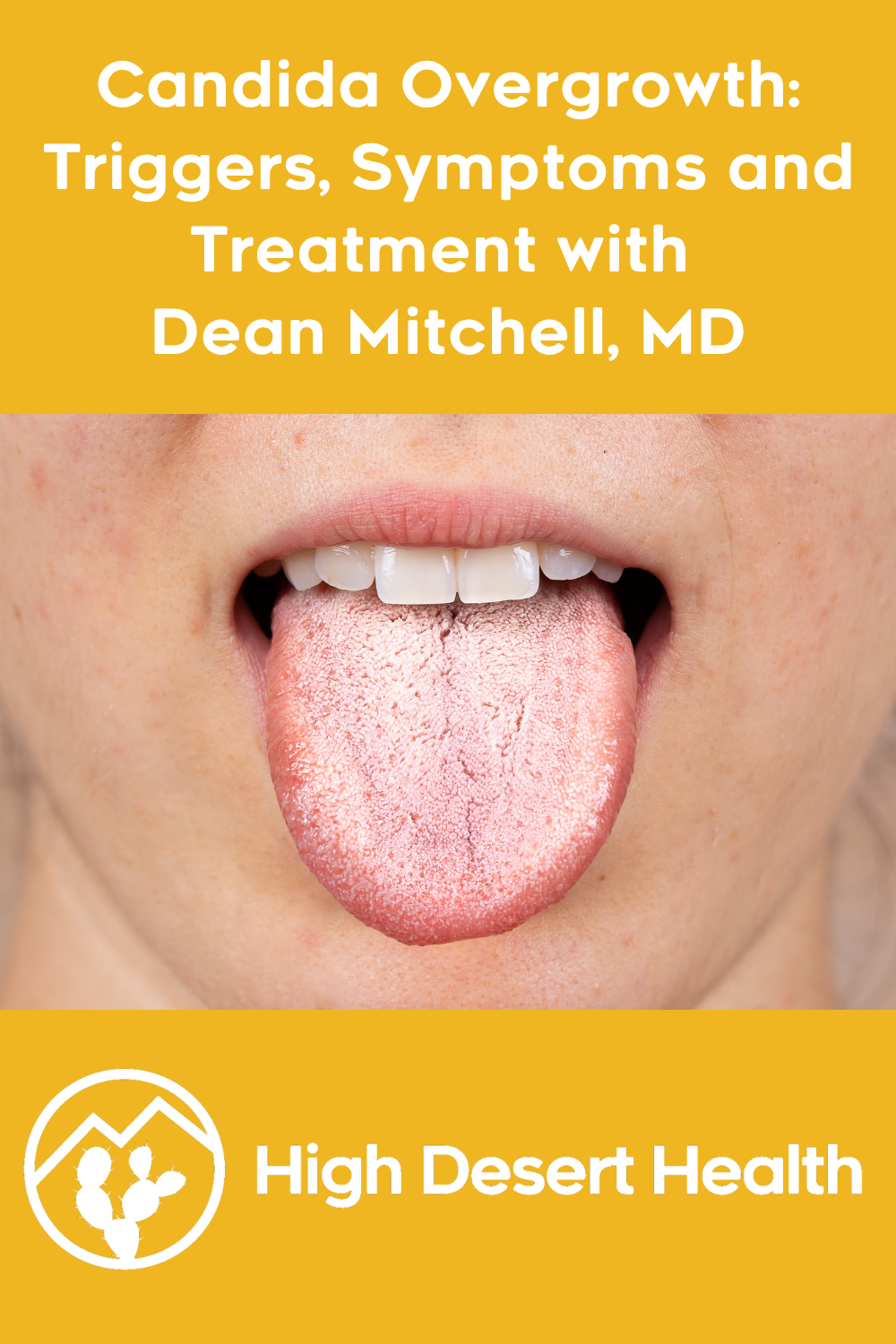
One of them was candida. A lot of these patients had oral thrush or white tongue. They could have other fungal rashes on their skin. They could have lung infections. A whole host of things, really severe stuff. So that was my intensive exposure to candida at the time. And then I went into private practice a few years later with my wife, Dr. Ricki Mitchell, who was also actually doing functional medicine a little bit before I was, and she trained with a doctor that had exposed her to this idea, this concept of candida overgrowth, which was very controversial then, little bit less now. And I really wasn’t involved in that part of the practice initially.
I was doing a little more allergy work and immunology. But interestingly, we worked together in the same office, and occasionally a patient would ask me, “Oh, I see your wife does functional medicine nutrition. Can I see her?” So I said, “Of course,” and sometimes it’d be a case that I couldn’t really figure out, and when it really hit me was when my wife saw a patient, there was a male patient, because I always thought only women could get candida infections, candida yeast infections, and this was a patient who was interesting.
He was a male. He was having a lot of body odor, fatigue. Really very not typical symptoms of anything. And when he saw her, afterwards I saw him leaving the office and he was so happy and he thanked me for letting him see my wife. I said to her, my wife Ricki, I said “What’s wrong with him? What did he have?” And she goes, “He’s got candida.” “Candida? He’s a guy,” and that was the beginning. And then over the years being in the practice and expanding my own practice into functional, holistic medicine, I started to recognize these patients, and I did the deep dive into the work that I could find, and I started to see also how well some of these patients responded to the candid diet, to vitamins, to antifungals, and that just took me to another whole level.
And I guess what happened after a decade or so of doing this, and also doing my podcast The Smartest Doctor In The Room, I got to interview so many top doctors in the microbiome and everything. I realized, it just dawned on me one day, candida is the classic, probably the most classic microbiome illness right now, and it’s all due to the excessive use of antibiotics, proton pump inhibitors, sometimes even topical steroids like inhaled steroids for asthma.
So it was all there, and I really felt that Dr. William Crook, who was the originator of this whole yeast syndrome as he called it, and got a lot of flack for it, but he sold hundreds of thousands of books to the public, that he was onto something. But now is the time to really validate the work that he did because the science was there. Long-winded answer to your short question. Yeah,
Lindsey: No. It’s an interesting journey.
Dean Mitchell, MD: Yeah.
Lindsey: So what symptoms do you typically see in someone with systemic candidiasis that distinguishes itself, say from SIBO or other GI diagnoses?
Dean Mitchell, MD: So that’s where you have to really keep your head on, seeing the big picture.
And the reason I’m saying that is that so many of these patients have been to multiple specialists. If they have skin infections, they’re seeing the dermatologist. If they’ve had GI issues that would have been unresolved, they’re seeing just the gastroenterologist. And the gastroenterologists and the dermatologists and the other ologists are not really, because they haven’t seen these kind of cases, are just like looking from their viewpoint. And so what ended up happening from doing a lot of this work, I actually have a chapter of this in the book, I actually staged the candida in patients because I was seeing from these stories that I was hearing over and over again an evolution.
So typically we all have candida in our gut. That’s normal. It should be there to some degree. But when it overgrows due to, as I mentioned, the antibiotics, proton pump inhibitors, stress is a big one. I always tell people it’s like eating 10 cookies. That it starts in the gut, and a lot of these patients present with an irritable bowel type syndrome where they’re having bloating, constipation. Some more than others, but typically a lot of the patients have that. Then what happens is I say it goes to stage two. It’s very clear in women because when they start getting the candida vaginitis, that’s from the gut. That’s like what we call the leaky gut.
The candida overgrowth has escaped the bowel and now is headed into the vaginal area, and the women get very uncomfortable, and they go to the gynecologist, they get a couple of pills, but no one changes their diet or treats the long-term issue with that. The other very interesting thing was, like with women and men, I see chronic sinusitis, because the sinus tissue is very similar to the vaginal tissue.
So I saw over the years too, so many, especially men treated for chronic sinusitis. They would go to the ENT, they would get more antibiotics, more steroids. This would just repeat itself over and over again till they were really full-blown candida. And if I treated the candida issue, their sinuses got better, and I saved them from an operation.
The third phase I used to find was what I would call the brain fog. When the candida’s been floating around for a while, it actually produces compounds called acetaldehyde and ethanol, which is alcohol, and that’s why these patients get this brain foggy feeling. And the fourth stage I’ve seen, a lot of times that’s when patients were coming to me initially because they’d been suffering for ten years or more, was the chronic fatigue and what we would call fibromyalgia.
Lindsey: Okay. And so do you often see that candida in conjunction with mycotoxins. Is that something you also test for?
Dean Mitchell, MD: Interesting. One of my other expertises is in toxic mold which it wasn’t originally, it was really more candida, but the last decade I got involved with that. A couple of patients had asked me.
I ended up training with some of the original founders in this area like Dr. Richie Shoemaker and now more Neil Nathan. And that opened my eyes because unfortunately too, toxic mold is so much more prevalent than I think I ever realized. So many people get exposure and if they also have candida, it’s like a big frat party going on. People get really sick.
Lindsey: Yeah. no I’ve been finding it a lot more than I would like to because as a health coach I can’t prescribe obviously so I have to send them off to their doctor hoping they might be able to get something, if that’s the route, but yeah. Yeah that unfortunately seems to be behind a lot of cases of IBD too. I’ve discovered.
Dean Mitchell, MD: It is kind of like the mysterious occult condition. Yeah.
Lindsey: So what do you do to test for candida or do you not?
Dean Mitchell, MD: That’s a great question and again, I have a chapter on that in my book and it is a little bit of frustration because there really isn’t a great test.
That’s why the history and the person taking the history – that’s why when I see patients, I’m the only one who takes the history. I don’t have the assistant or you know like telephone taking the history and me walking in for five minutes. I’m listening. I want to hear the whole evolution of the story because the history is key.
There’s just nothing that separates it. I also have in the book 15-question questionnaire that really helps detect whether you have a lot of the things that make you predisposed to getting candida. Unfortunately stool testing, not very helpful. Candida is rarely picked up in the stool.
Sometimes it is, but it’s rare. Urine also indirect methods. You can sometimes check some mycotoxins like gliotoxin, but again, not absolute. Blood testing, I don’t find valuable. You know those immunoglobulin antibodies, a lot of people have them. I used to do a skin test for candida which I thought was helpful, but I’ve moved away from that.
What I’m really hoping, the big secret, I’m really hoping, and I’ve been talking to some companies. I’d love them to come up with a breath test very similar to SIBO because it makes sense, and I think it’s doable, and I’m just trying to get in touch with some companies that will help develop this.
The thing is Lindsey, it’s interesting, and I just did podcast on this myself that’s going to be released next week, is auto-brewery syndrome. I don’t know if you’re familiar, but Dr. Crook described that in his book because there were cases of that even back in his day in the ’70s or ’80s where people literally became intoxicated without having a drop of alcohol from eating carbohydrates.
And the reason these cases came up, because a lot of times these patients ran afoul of the law. Like they would go through a stop sign or something, and they’d get pulled over, and the policeman would smell alcohol on their breath, do a Breathalyzer test which measures the alcohol, and these people would fail.
And then the patient, the person would say I wasn’t drinking alcohol, and meanwhile they’re going through a whole DWI issue and so got me thinking that, gosh, if the police can measure this, I think as scientists and doctors, we could measure that, and some other things as well. So I think a lot of cases where I find, like with SIBO, small intestinal bacterial overgrowth, when patients don’t really get better, and there’s unfortunately a lot of them, I find that it’s really more likely what we call SIFO, small intestinal fungal or candida overgrowth.
Lindsey: So you don’t find the organic acids to be useful in measuring it?
Dean Mitchell, MD: Yeah, very limited.
Lindsey: Okay. So what prescription and natural treatments do you use for candida, and for how long?
Dean Mitchell, MD: Yeah. So I came up with my protocol, and it was a combination of a lot of other good people’s work, and I’ll tell you why I do it the way I do it.
So the first part obviously is the diet. If someone’s going to continue to eat foods that are going to aggravate the condition like fast food, simple carbs, pizza, pasta, all that stuff, rice all the time, it’s going to be tough to get better. So we do put them on a diet, but we do have, we have coaches also. I have a dietician, my coauthor Joelle Mitchell, who’s now my daughter-in-law. And I really worked with her closely to come up with, I think, a very doable diet, so we have that in the book, like a 30-day plan. Because, yeah, it is a tough diet, but it is doable if you learn to make substitutions.
But as one of my interviewees on my podcast, Dr. Marjorie Crandell, who was a candida researcher for many years, a PhD, she used to like to yell out, “You can’t cure candida by diet alone.” And she knew from her own experience with this. That’s why she was such a proponent of being treated, and that’s why when patients come to me and I’m able to make the diagnosis, I will use antifungal medications with them, which are very effective.
It’s just unfortunately a lot of times, even the gynecologist, they do it for too short a period of time. The candida is a very hardy organism. You need at least three weeks. Dr. Satish Rao in Georgia, who’s done work on SIFO, has shown that, to get these patients better. But I will say, with the other thing I do, which is part of the functional medicine that I do, I usually put these patients on some form, depending on their stage, some form of vitamin therapy injectable, either intramuscular injections or IVs.
And the reason being is that early in my career when I didn’t do that because I didn’t know, about 30% of these patients had what’s called the die-off or Herxheimer reaction, and they were very upset, very. They were already feeling bad. They started to feel worse. And I found by doing the vitamin therapy, we’re really able to decrease that significantly.
So I’ll typically while I’m doing the antifungals, I have them getting vitamin therapy, which they can either do at home or in some cases, obviously, if it’s an IV, they have to come to my office, or they find someplace locally that can do it
The last part of the treatment, which is also I find effective, is I do special sublingual candida immunotherapy drops. I was one of the pioneers in sublingual immunotherapy about 25 years ago. And when I was doing just pure allergy, I was frustrated with doing the allergy injections. A lot of times people had bad reactions to it. The compliance was very low, like 20%, because again, people just don’t want to come every week for a shot.
And when I learned the Europeans were doing immunotherapy sublingually, I was like, “This sounds brilliant. Why aren’t we doing this here?” And of course the answer is insurance, and the medical societies. They really wanted more control. They didn’t like it. But the literature was there. It showed that it worked, so I jumped in.
It was a little controversial as I can be in my own way, but I just saw the upside was huge and the downside was quite low. So I was doing… I’ve been doing that for 25 years, and I extended that to candida. Because I found that when I use the sublingual immunotherapy drops, which are basically natural immunotherapy drops, I’m able to get the patients off the antifungals and get a more permanent protection.
Lindsey: So back to the treatments. So prescription, are you using nystatin or fluconazole?
Dean Mitchell, MD: I typically start with something stronger, because again most of the patients coming to me really need a more systemic antifungal. So I’ll typically start with Diflucan or fluconazole.
Sometimes I need to go to strong ones, because sometimes patients have been on that already and are resistant to it, so I’ll use Sporanox or itraconazole.
And sometimes I’ll use even the more powerful ones like voriconazole or posiconazole, which are more powerful. They’re also more powerfully expensive. So I try to use the other ones first, and usually most of the time, probably 80% of cases, I could get away with the first two. And then in the more resistant, difficult cases, I have to use the stronger ones.
Lindsey: And you said that’s usually three weeks’ worth?
Dean Mitchell, MD: That depends- Yeah … on each case how somebody responds.
Lindsey: Okay. And are there people that for whatever reason maybe they’re out of state that you need to use natural treatments on?
Dean Mitchell, MD: Yeah. So this is how I work out of state because I’ll do what’s called an educational consultation for people who really want to be guided.
And then they really have two choices. They can fly into New York where if I see them, I can prescribe for them. And a bunch of patients do that. If not, I tell them I’m totally willing to work with them and their local provider if they can find somebody that’s open to understanding, and maybe get my book, show it to them, and let these doctors know that they can help them with the proper treatment.
Lindsey: Yeah. How do people talk to their doctors about this? Because, as I said, I’m often sending people to their doctor to get itraconazole for mycotoxins.
Dean Mitchell, MD: No I do feel that the patients have a better chance if they find a functional medicine doctor who tends to be more open to this and is aware of this. I find more of my allopathic conventional colleagues are still in the dark, where the patients with their ChatGPT and Dr. Google really have a lot of information. They come in super well versed in this. So I love having discussions with them, but I just try to give them my experience to get them better faster
Lindsey: Yeah. So you don’t work with the natural stuff, you always work with the prescriptions?
Dean Mitchell, MD: Basically? I use it occasionally. I do find it works gentler. I think once a patient’s very stabilized, it’s fine. I just have found in my experience… I’ve had people on the candida diet sometimes for years, they’ve been taking a whole bunch of supplements, and their symptoms will get 20% better.
And then they go with the medications and my candid immunotherapy, and then it rockets to 80, 90%. But then I’m fine with it. Yeah. I just don’t like people spending a lot of money on a lot of things that have varying success.
Lindsey: Yeah. So you said you don’t think the blood immunoglobulin markers are valuable, because I did the Candida + IBS Profile from Vibrant and had a positive. It’s not necessarily indicative of an infection, or it is..
Dean Mitchell, MD: I don’t think it’s really telling you anything, because we have some antibodies in our body. I’ve seen it up, down, nothing, nothing impressive. And it just, you know- Yeah …”Doctor, I really need something.”
Whereas I will tell you the mycotoxin test, which you’ve mentioned a couple of times, you know, the work that I do in, the Real Time urine mycotoxin test that I use for people exposed to toxic mold, I find to be excellent, and I really can use that to help guide a patient detox from toxic mold, which is a pretty bad condition to get.
Lindsey: So you mentioned, let’s talk about the diets. So there are more and less extreme candida diets. So mushrooms, yes or no?
Dean Mitchell, MD: Before I answer all that, which is fine, because a lot of people have all the specifics, my approach to diet is this: back in the day, like diabetics, it was extremely severe because we didn’t have the arsenal of weapons we can use to help people get better.
So that being said, I also try to be… I want people to get better, but I want to be practical. I don’t want people becoming antisocial. These are things I really emphasize in the chapter in the book. So I say, “Look, we want you to be about 80% good. There are some no-nos,” I’ll get back to the mushrooms in a minute.
Try to be good 80% of the time. We’ll help you through the rest. My big keys are high fiber foods, so good for your microbiome and your gut. Low glycemic foods in general. So there aren’t a lot of foods with that. Again, I have a lot of people on ground flax seed, which helps their microbiome. I love people taking berries and apples.
Sometimes the old candida diets are like no fruit. I don’t think that’s a good thing. I think your body and your intestines need the good fiber and the water that vegetables and fruits give you. I don’t think fermented foods… I know fermented foods are not good for candida patients, so I will have them stay away from mushrooms.
And I tell them, because, some of the patients that I’ve cured hopefully over the years, sometimes when I hear from them years later, the typical conversation goes like this: “Dr. Mitchell, everything’s back. I’m really bad.” And I’m like, “Okay, what happened? Were you on antibiotics a lot, something happen?”
“No, I’m so healthy” and she goes, “I’ve been, drinking kombucha all the time, and kimchi, and this, sauerkraut.” And I’m like, oh no. Fermented foods really are never good for a patient with candida. It just, that’s something that tends to have to be avoided. So mushrooms are a no.
Lindsey: What do mushrooms have to do with fermented foods?
Dean Mitchell, MD: Well, they’re like also in that fungi family also, so it’s not a great idea.
Lindsey: And so do you also have them avoid things with yeast like vinegar and..?
Dean Mitchell, MD: Again, when people want to drink alcohol, which is always the big thing, I always tell them, bring your lawyer when you come to me so we can negotiate. But, I tell them, you’re better off like what the women do with the skinny martinis, the less sugary kind of drinks. If you have vodka or something like that, put with a splash of something to make it enjoyable. But beer and wine not the best choices really.
Lindsey: Yeah. Okay. And so the injectable vitamins you were talking about, is that like glutathione so for detox or . . .
Dean Mitchell, MD: Yes. We use B12, magnesium. Glutathione is very important to help the liver cleanse itself, and especially when we have them on the antifungals. Yeah.
Lindsey: Okay. So if you treat somebody for candida, and it just keeps coming back, are there genetic factors that may be at play?
Dean Mitchell, MD: I don’t really think that it’s genetic. Again, I think it’s microbiome, but I tend to find that the patients get… honestly get better. We have a pretty high success rate once they’re treated properly.
Lindsey: Yeah. And so they can go back to a less severe diet?
Dean Mitchell, MD: There are two patients I would be concerned about in my experience who chronically are not getting better. One, if they’re in a toxic mold exposure. That was the trick that I didn’t realize for a while.
I was like, in the beginning before I really understood about toxic mold, I’m like, “I’m treating this candida patient. Why aren’t they better?” And then we found out, oh my God, their house has mold in the basement, this and that too.
And the other one, if somebody really had a true immune compromised state, and I check, their immun-… That, that’s the other great thing about my medical background as an immunologist, I know how to check T cells, B cells, immunoglobulins, in case somebody is at . . . but I’ll give you an example too actually what’s interesting, like patients with celiac disease.
Now, that gets a little confused a lot with candida because a lot of people always come in “I’m allergic to wheat,” or they’ll come in and say, “I have celiac.” And I have to tell you, nine times out of ten it’s not celiac, it’s candida.
But a lot of the celiac patients, if they… And I have had some that are true celiac. A lot of them are sometimes deficient in certain immunoglobulins. I actually have a great story though I should share. There was a case several years ago, a woman in New York came to me. She was a Jewish Orthodox woman, and she came to me. She goes, I’ve had a lot of bowel problems.
I get these yeast infections, but she goes I’m almost positive I have wheat allergy or celiac or something like that, and, can you help me?, ” et cetera. So I was getting ready to do all the tests that I wanted to do, but it’s funny, at one point she said something that really struck me.
She goes, “Dr. Mitchell,” she goes, “I feel so much better when I avoid wheat, so it’s got to be gluten.” She goes, “But the only thing I can’t figure out” she said, “is that during Passover when I eat, matzah, the flatbread”, she goes, “I’m fine because there’s no yeast in that, but it has a lot of wheat.”
So again, I’ve seen cases where there’s a lot of confusion between those two diagnoses
Lindsey: I thought it was in your book maybe that there was the pointing out that candida can lead to celiac. It wasn’t in your book?
Dean Mitchell, MD: Two separate things, but they can be confused. And I always say too, I tell my candid patients today, “You should be so grateful for celiac patients,” because they started such a movement getting gluten out of, or giving, making sure there were choices when you go to restaurants and everything.
Today, to go to a reasonably nice restaurant, you have so many options. You don’t have to feel like you are a pariah socially or, with the restaurant establishment.
Lindsey: This is true, yeah. So are there nutrients that may be important for keeping candida at bay?
Dean Mitchell, MD: Yeah, that’s a great question. Thanks for bringing that up. One of the things that I do when I, before I even start the vitamin therapy, is I check patients’, besides their regular cell counts and their liver functions, I check their certain vitamin levels, like B12, magnesium, and zinc, iron. And, more often than not these patients tend to have low levels.
Now, what would happen a lot of times is the patients’, sometimes their doctors won’t even check those things, but even if their doctor did check it, what I find is that it’s overlooked because they’re in the range, but they’re in the lower end of the range. And I always try to explain to patients if you ever checked your B12 level and you see the range, it says from 200 to 900.
If you’re below 450 or 400, you’re already starting to get into a danger zone. So the lab is really misleading you in a way. And again, a lot of times I understand doctors look at what the reference range is, but when you’re in that lower category, that’s not a good thing, and that to me is indirectly telling me your intestines are not working properly to absorb the vitamins and minerals that you really need to keep your immune system strong.
Lindsey: Yeah, and then the serum B12 is like the latest marker. Like so many other things will go south before that one goes south. So the immunotherapy for candida, where do you get it first of all? And do you give it to everybody or you assume there’s sort of an immune overreaction with everybody, or is it… Who is it appropriate for?
Dean Mitchell, MD: It’s selective. We make it in our laboratory, the same way allergists can make their allergy extracts in their laboratory, we have control. We know what we’re doing. Again, it really would be for patients that are suffering with a chronic issue, that want more protection so that they can hopefully decrease their need for antifungals.
Like I’ll tell you another interesting story. I saw once a gentleman, very athletic guy. He was in his mid-30s, and he’d been… before he came to me, he was seeing another doctor who’s very well known in the candida community. He had been around for many years. And that doctor didn’t have as many tools as we have today.
And so he was treating this young man who really had severe candida. Like he said, he couldn’t eat a simple carb. He would just go to sleep. And it was kind of funny actually once because he came into my office one day with a big duffle bag. So I was like, “Oh, you’re going on trip?” He goes, “No, that’s my food in there.”
Wherever he went, he had to travel with his food, and because he had to have what he needed to keep him feeling good. And he was also on eight Nystatin a day, which is really a lot. He goes, “Dr. Mitchell, this is… I can’t drop it. If I go any lower, I’m…”Pshh, okay. So I said, Let’s get to work,” so we did the vitamin therapy with him.
I did a little bit of the new antifungals slowly but surely because he was a little nervous. I lowered his Nystatin, and then I got him on the drops, and we were able to get him off the Nystatin completely and he was very happy.
Lindsey: Yeah. Okay. And it’s just a tiny amount of candida in . . .
Dean Mitchell, MD: Yeah. It’s like typical desensitization.
The way I like to explain to patients is it’s like a 10-story building. We start at the basement. We start at the lowest doses, with the protein from the candida. Get your body exposed to it. You do that for a month, then you go to the next higher level. Almost like working out with weights.
Just slowly till we get up to high levels, and your body’s generating its own specific antibodies to the candida to keep it in check.
Lindsey: Okay.
Dean Mitchell, MD: I think what you were going to ask me, but I think it’s important and worth repeating, again, people are so educated and being proactive in their care, which I think is fantastic.
That’s one of the only best things about this whole AI revolution, that they’ll put their symptoms into the chat now, that used to be Google, and it would give them some very good information and say, again, based on questionnaires and everything, whether they’re likely to have that. And then that’s when they start searching to find somebody that’s an expert in that area.
Lindsey: Yeah. Anything that I have failed to ask about on this topic?
Dean Mitchell, MD: You covered a lot of really good things. But I want to just repeat one thing that we just started talking about, I think before we went on air, because you mentioned how you do work with irritable bowel. And I mentioned that on my podcast, The Smartest Doctor in the Room, I’m so lucky I get to interview a lot of other top doctors or PhD researchers.
So I… People always laugh when I say the name The Smartest Doctor in the Room. They look at me like thinking, “Oh, I’m the smartest doctor.” I said, “No, it’s all the people I interviewed.” But I could change the name to Becoming the Smartest Doctor in the Room, because after talking for five years to these people, I think I have gotten a lot smarter.
But one of the people that I so respect is Dr. Mark Pimentel at UCLA. He is really one of the leading GI microbiome researchers in the world. He has his own Pimentel labs. He puts out amazing work on this. But, in our conversation I’ll bring up two important things for your listeners.
When we were discussing about the microbiome, he made such a great analogy. He said, “A healthy person has a very diverse microbiome,” especially in the gut. That’s what is the hallmark of a very healthy person. He said an unhealthy person or problems they see with irritable bowel in his clinics, they have a more homogeneous microbiome, and that can be due to a lot of factors: medications, aging, all the things we were talking about before.
And he made the analogy that it’s almost if you take a city. He goes, “The city works really if you have a whole bunch of different occupations there: lawyers, doctors, plumbers, you know, sanitation workers. You need them all. If you just wiped out and just got stuck with lawyers, you’d have a lot of people suing each other but nobody taking out the garbage.”
So you really need that diversity. And the other really important thing just for your listeners also, which is always shocking to people, I had asked Dr. Pimentel about probiotics, because we always assume probiotics are a good thing, and I didn’t really find that in my own practice. I don’t take it personally myself. It bothered me.
And over the years interviewing different researchers, most of them also said the same thing. They didn’t take it for themselves and the data was questionable. And Dr. Pimentel definitely pointed out there’s some big studies that in IBS probiotics are not a good thing. They can make things worse.
Those are things I pointed out in the book because again I thought all this information was important. And I thought, as I said, I opened up very quickly for the science part of this to get… even if a doctor is reading this book, which I have had; many colleagues read it, let them see the science behind this that this is not just some made up diagnosis.
Lindsey: Yeah. So speaking of a diverse microbiome, is there a role for fiber in rebuilding the microbiome then post-treatment or during?
Dean Mitchell, MD: Absolutely. Again, like I said, I think in the diet part I stress so much… what I think the best thing you can do for your microbiome is natural prebiotics through high fiber foods.
This is what the good bacteria like in your gut. You don’t have to take a pill, and also I mentioned this in my section on herbs. As I said, the only herbs I really like are the ones that you sprinkle on your food, whether it’s turmeric, basil, ginger, that’s good stuff.
Once you put it into a pill, now it’s closer to a pharmaceutical than an herb
Lindsey: Yeah, there’s a lot of strong stuff people are using and-
Dean Mitchell, MD: You start putting the dosing, you-
Lindsey: Wiping out their microbiome with it.
Dean Mitchell, MD: Yeah, if you go up to 2500 milligrams with like turmeric, you’re thinning your blood. It’s like people need to know that it’s now a medicine. It’s not an herb anymore.
Lindsey: So you’re talking about just heavy fiber foods as opposed to added fiber?
Dean Mitchell, MD: Oh, that’s all, all the good leafy green vegetables, cruciferous vegetables. There’s a whole list of them, and they can really make… Joelle has a lot of suggestions how to make the meals delicious and appealing.
Because I don’t want people being bored or not looking forward to eating or eating out with their friends. Because you could go to a restaurant, and I do this all the time, my… A lot of my friends tease me, “Oh, he’s going to eat the healthy stuff.” But I feel better after. If I ate the crappy stuff, I’d feel horrible after.
I might feel good. I might enjoy myself for a few minutes, but it’s really not worth it. I’m not saying I don’t cheat once in a while. I do. I tell patients, I’m very honest with them. I’ll probably have a pizza once or twice in the summer and then I’ll enjoy it, and if I have one, I’m good.
If I had it every day, I’d probably start feeling sick, because I’ve struggled with candida myself earlier in my life. So it’s really just making those substitutions, having the right foods in your house so you don’t end up eating the wrong foods.
Lindsey: Yeah. So tell people again the name of your book and where they can find you.
Dean Mitchell, MD: It’s called Conquering Candida. You can get it on Amazon. Think it’s hopefully an enjoyable read with a lot of practical advice. And like you brought up before too, Lindsey, for any patient that’s outside of New York State and really wants to work with their doctor, they should bring them this in with them.
I hopefully, if you really have a doctor, like the new type of doctors would be open to this type of thing. I know back in the day doctors used to be intimidated or defensive, I should say, if a patient came in, “Oh I read this, I did that,” the doc went, “Ah, sh…you, what could you know?”
And it was kind of true because we had… one thing that’s true, we had the cartel on information. We got all our stuff from the medical journals. Great. But now information is so widely disseminated that doctor and patient are on equal footing, and I feel, I tell my patients after we have a whole in-depth discussion, I said, “The only reason maybe you’re coming to pay me to help you get better is if I’ve treated a thousand patients with this, I know the path to get you there the fastest.”
Lindsey: Yeah. Okay. Thank you so much for your time, and for sharing this information, and writing the book so that other people can have access to it and other doctors can look at it and open their minds.
Dean Mitchell, MD: Superb. Thank you, Lindsey. It was a pleasure being here.
If you’re dealing with gut health issues of any type (diarrhea, constipation, bloating, SIBO, IMO, H2S SIBO/ISO, IBS, IBD, gastritis, GERD, H pylori, diverticulitis, candida, etc.) or have an autoimmune disease and need some help, I see individual clients to help them resolve their digestive issues or reverse autoimmune disease naturally, You’re welcome to set up a free, 30-minute breakthrough session to see if you’d like to work with me. I also have my own two products, Tributyrin-Max, which is particularly helpful for loose stool and diarrhea as it slows your motility and firms up your stool, and SBI powder, which is an all around gut pathogen binder, which is super safe and won’t harm beneficial bacteria, and is usually the first line of treatment I educate my clients about in order to avoid stronger antimicrobial herbs.

*Product and dispensary links are affiliate links for which I’ll receive a commission. Thanks for your support of the podcast by using these links. As an Amazon Associate, I earn from qualifying purchases.