

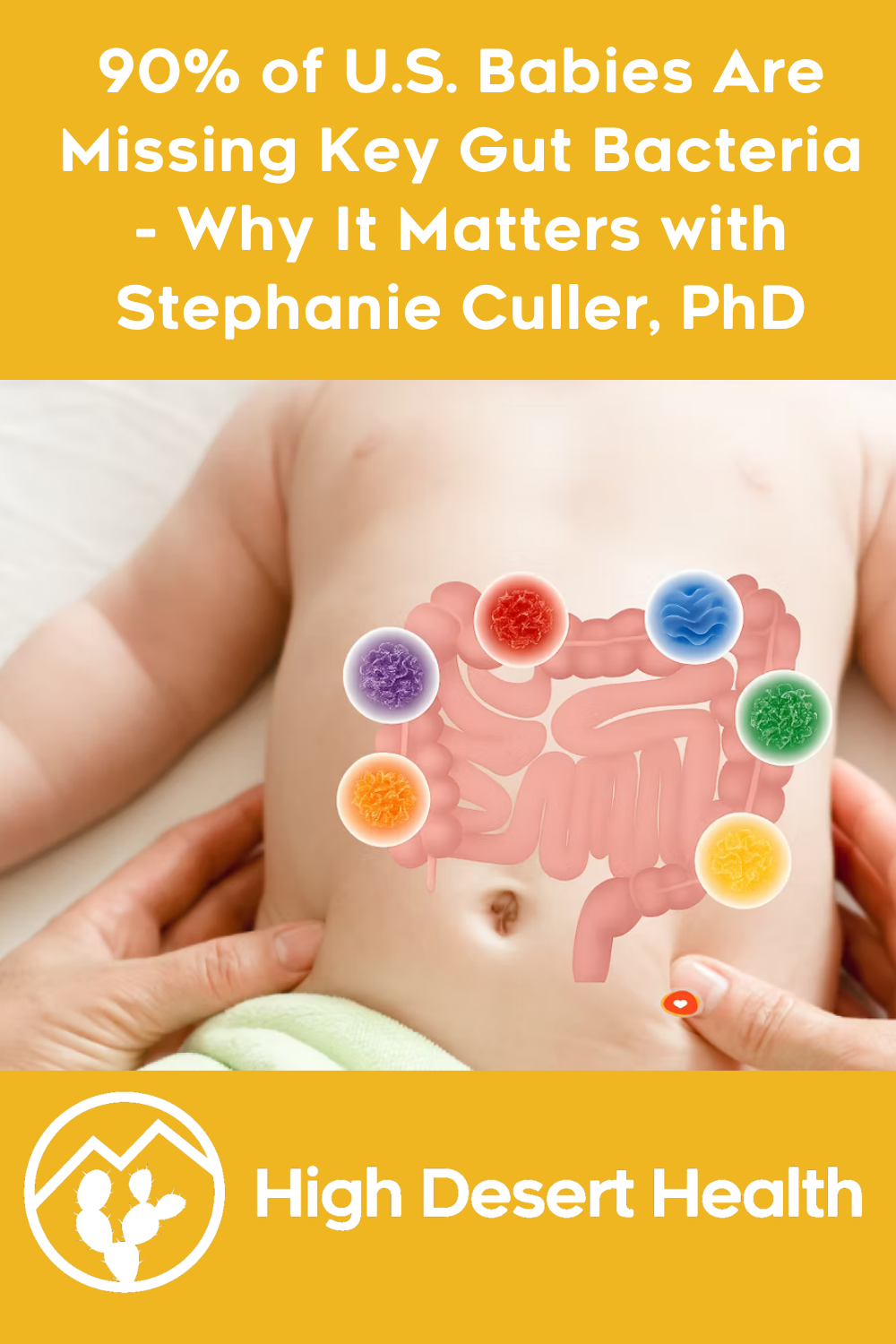
Adapted from episode 166 of The Perfect Stool podcast and edited for readability with Stephanie Culler, Ph.D., co-founder and CEO of Persephone Biosciences Inc. (use code perfectstool30 for 30% off) and Lindsey Parsons, EdD.
Lindsey Parsons:
So can you tell me about your research on the infant microbiome and what you’ve learned from the study that you did?
Stephanie Culler, PhD:
Yeah, absolutely. So we’ve been studying the infant microbiome for several years now. We launched three years ago, the largest study ever done in the United States to map the infant microbiome, called the My Baby Biome Study. We published a few months ago in a Nature Portfolio journal. And what we learned from looking at the microbiome of babies from 48 out of 50 states is that most babies today, about 90% or more, are missing key types of gut bacteria called Bifidobacterium. These are really fundamentally important microbes that make the foundation of the baby gut, that help train the immune system, and we think it has connection to brain development, and with that missing means that the wrong microbes are getting into its place, and when that happens, children are much more likely to get errors in their immune system development, and we think it’s linked to a number of chronic conditions, including eczema, food allergies and asthma.
Lindsey Parsons:
So I’d always heard that the first one was the Bifido infantis. Is that what you found as well, or are there a number of them?
Stephanie Culler, PhD:
Yeah, Bifidobacterium infantis is one that we found that was the one that was over 90% missing, in addition to other species of Bifidobacterium. In our data, using AI on this really large dataset, told us that there were three types of Bifidobacterium really important for babies, for their immune system development, and for the long haul- you and I should have all these types of bacteria. But I think what was interesting about it was that about one out of four babies were missing this type of bacteria, in general, just completely gone. And again, the entire genus, the whole genus is missing, which was really surprising to us, and a sign that potentially these species are missing and going away. They’re going extinct, potentially.
Lindsey Parsons:
And what did they have instead?
Stephanie Culler, PhD:
That’s what is very concerning. Instead, they had potential pathogens, infectious organisms, those that have been associated with cancer, even colorectal cancer and other diseases. And so in that situation, it’s a very inflamed environment. Many of these organisms produce toxins, which we have validated, they also have higher levels of anti-microbial resistance right off the bat.
Lindsey Parsons:
So we’d love to get into names and details here, people do gut reports so they see these names, they know these things. So what were the pathogens? What were the other Bifidos?
Stephanie Culler, PhD:
So the three species of Bifidobacterium that are of most interest coming from this study, of course, is the Bifidobacterium infantis, the one that can use all of the human milk oligosaccharides in breast milk, special prebiotics only found in breast milk. In addition to that, are other HMO users, Bifidobacterium longum and Bifidobacterium breve; those two while they can consume some HMOs, they’re really good at degrading plant-based fibers. And so that was what was really interesting coming from our research. It’s not only the true infant strain, Bifidobacterium infantis. It’s others that support the growing gut ecosystem, starting in toddlerhood, and so those are the key Bifidobacterium that we’re finding to be super important for infant and human development. But on the flip side, when those are missing, we saw an increase in Clostridium perfringens. This is actually an organism, in some cases, that is infectious, associated with gangrene sepsis. We also saw Clostridium difficile, which is highly infectious. Many newborns do get Clostridium difficile and are treated with antibiotics. Sometimes that the pediatricians and parents detect as blood in the stool, sometimes that is linked to C. diff.
Other bacteria that we saw even connected to diseases, but also potentially could be pathogenic are the normal E. coli’s. But various strains of E. coli, we saw Klebsiella in many cases, and for some of them, they contain toxins that are associated with disease, specifically the E. coli and Klebsiella were detected in that manner. Some babies had very, I would say, low levels of Fusobacterium nucleatum, for example. This, in some studies, has been linked to colorectal cancer. That is a biomarker in that field, which we’ve extensively focused on. And so I would say that’s the key variety that we have observed, but definitely alarming, because these were newborns. This is a seven-year study. The kids are now three. Newborns should really have very high levels, maybe even upwards of 80% at least 50% of their gut should be Bifidobacterium. And so we’re now seeing, with Bifidobacterium gone, the ecosystem collapses, right? And so we see anything that’s really opportunistic, that can utilize oxygen effectively taking hold in its place.
Lindsey Parsons:
So presumably, some of these Bifidobacterium are coming during birth, or are they transferred before birth? Do we know this?
Stephanie Culler, PhD:
Well, we don’t think they’re transferred from before birth. That’s an ongoing discussion in the scientific field. But the data that we are getting, I would say, in the last about three years or so, are really suggesting, if vaginally born, they do get many of these, or much of these at birth, if mom has it or if it’s available, and namely, through exposure to the mother’s gut microbiome. The birth canal and the vaginal microbiome is very simplistic, lots of Lactobacillus, but not the key diversity we see in the gut. And so that’s how it’s been clear to scientists and done a lot of studies looking at exposure of the mother’s gut microbiome, and what’s in common with the mother’s microbiome in the child, and that’s what’s led us to think that the majority of this seeding event happens at birth, but from the mother’s gut microbiome.
And this is in complete contrast to C section born babies, because C section born babies automatically get the microbiome of the hospital, that early environment, but then also skin microbiome from families. And there’s been some really elegant, in a couple of Nature journals recently, I would say, in the last six months, studies that published looking at birth cohorts and the mother’s microbiome, and noticing that children do get Bifidobacteria, sometimes a little bit later on after birth, if a sibling has it, or it’s in the daycare environment, and so it gets shared. I would say those are a little bit harder to get, at those time points. But when we looked at our study, this was in newborns. This was the slate that we saw that most babies are missing these, these high levels of Bifidobacterium.
Lindsey Parsons:
So to get down and dirty, when babies are coming out of the birth canal, they’re supposed to be upside down, and there’s often expelling of feces, yes, this is not by accident?
Stephanie Culler, PhD:
No, it all seems to come together. And then breast milk having the prebiotics that – they’re not feeding the child. The third largest component of breast milk are human milk oligosaccharides. Over 200 kinds of them, they don’t feed the child, they feed the bacteria. So we have evolved over millennia to have this perfect link. Mom, giving the right microbes to the child, then giving breast milk that feeds those bacteria and child. It’s an interesting thing.
Lindsey Parsons:
Yeah. Now, do any bacteria come through the breast milk? Can you make up for a C-section with breast milk?
Stephanie Culler, PhD:
Unfortunately, no. I mean, we think that there are some bacteria, maybe some Lactobacillus, but when we look at a lot of breast milk and the microbiota, it’s a lot from the skin, if that makes sense, given that organ and the exchange of the microbes, and maybe some oral microbes from baby, for example. So it’s hard to tell, but it’s also at a very low amount. I would say that the gut microbiome has more than 1000 times bacteria for an infant than breast milk, so maybe a little bit, but from our study, as well as other studies around the world, when the child is missing these Bifidobacteria and the child is fed breast milk, the wrong microbes still thrive because they have adapted, or they have certain enzymes that can, serendipitously, also use HMOs. So it’s kind of an incomplete picture.
Lindsey Parsons:
So I know back 5-10 years ago, when I was starting to look into this whole microbiome thing, and I had, well, I have a child now, who’s 22 so I guess it’s been a while, but I don’t think I knew this at the time he was born, which was by C-section. But I know that for a while there they were talking about trying to swab the vagina and then seed the microbiome. So now that they know that it’s probably coming from the stool, are they actually, I assume they’re not swabbing the stool and putting it in the C-section baby’s mouths?
Stephanie Culler, PhD:
No but that has been a topic of discussion, but I think it has been raised a few times. And I think some groups are doing fecal transplants, but into young children. But I would say that’s not and that’s where really, how do we put what’s missing, and how do we put it back, came about.
Lindsey Parsons:
Right, right. So do all children who are born vaginally have good microbiomes then, and if not? Why not?
Stephanie Culler, PhD:
Sadly, no, the majority of the babies in our study, regardless of whether they’re vaginally born and even breastfed, their microbiomes are still compromised. And we found in our study that roughly about three out of four babies in the United States have what we determined to be an unhealthy microbiome, meaning that they either have low or no Bifidobacterium. And why we determined that this was an unhealthy state is that by year two, because of health outcomes, these are the children that are at three to four times greater risk for developing eczema, food allergies, asthma, and we think other conditions. And this is complemented by other research, and it all comes down to this: it’s nothing that we as parents have done. It has nothing to do with that. It’s all about modern life. It’s about having a baby in this modern era, because we think that the change in the microbiome has happened over the last several decades, and the impact has come from antibiotics, C-sections, potentially infant formula because it doesn’t have those prebiotics or probiotics, and also poor diet and lifestyle. And we think all of those have been impacting, one, the mother’s ability to have those microbes, and two, the child’s ability to get them or even be exposed. We see less of these microbes in the environment.
Lindsey Parsons:
Yeah. I look at microbiome reports all the time for my clients, and low Bifido is very common, but low butyrate producers more than that. Of course, this is a more adult microbiome, but it’s the same story. I just look at the same story over and over again. The question is, which pathogen overgrew instead of what’s supposed to be in there?
Stephanie Culler, PhD:
And I think what’s really elegant about this, and what I think truly fascinates me, is that Bifidobacterium are having a renaissance. In the last few years, there have been so many high-impact publications, because we’re finally now getting to the genetics and the function of these miraculous bugs. There’s a reason why the human gut microbiome starts with them. They produce the right acids, or short-chain fatty acids, the acetate and lactate, which help bring down the pH of the early gut, which is exceptionally important, because that inhibits pathogens from growing. But in addition to that, they also have secret weapons, they produce bacteriocins. These are peptides that can bind to potential pathogens and inhibit them from growing further. And in addition to that, from the right HMOs, they produce metabolites, basically indole-3-lactic acid, 4-HPA, these tryptophan metabolites that come from Bifidobacteria that engage the immune system to reduce inflammation and allow it to develop properly. So they really set the stage for proper development of the gut, but also just how the gut works, because the byproducts, you know what it makes, acetate and lactate, it also gets eaten by butyrate producers. And so if you put back Bifidobacteria, you should, and we see in our clinical trials as well as others, that all of a sudden the butyrate producers are happy. They’re growing and they’re producing more butyrate. So it’s an ecosystem of cross-feeding that’s really important here that sometimes people don’t think about as well.
Lindsey Parsons:
So then, have you studied how the microbiome continues to develop over those early years, and when does the child reach a more adult microbiome?
Stephanie Culler, PhD:
The adult microbiome starts to, or the child’s microbiome starts to look much more like you and I’s around age three to four. So as they go into kindergarten, it looks much more like ours. It is still developing over time, but that rapid, dynamic phase, from starting out with just a handful of microbes a little after birth, stops around age three or four. But it is a highly dynamic period, because the whole ecosystem is actually blossoming at that point, from a dozen microbes to hundreds, like what you and I have.
Lindsey Parsons:
Now, I know that autism is on huge rise, and I’m wondering whether there’s any research between the microbiome and autism.
Stephanie Culler, PhD:
I would say there’s a lot of research being done right now globally, in fact, and a number of key publications are starting to suggest that the microbiome is very much a biomarker. We are noticing in autistic children that their microbiome is somewhat different, and we’re trying to better understand what that means. And I think there is emerging data to start to look into causal relationships, as well as how microbiome transplants have been shown to be helpful for adolescents with autism. So I think the field is really emerging in that area, and that’s very much of interest to us too: if we can help better develop the infant microbiome, is there an opportunity to reduce rates of autism? Could we have an impact? And then, on the flip side, can microbiome modulation be used effectively as a treatment?
Lindsey Parsons:
Yeah, and a lot of children I know are getting lots of antibiotics, sometimes at birth, because of, I don’t know, maybe like strep B or because of C-sections or whatever else. So what can you do? And/or your child’s born by a C section? What can you do at that point? How early should you intervene?
Stephanie Culler, PhD:
Yeah, absolutely. You know what the global data is really suggesting, in addition to the My Baby Biome study, is that this should be standard of care. Kids today, modern kids, need to be exposed to it in whatever way, right, and especially those via C-section and those that have received antibiotics. Kids and infants that have received antibiotics within the first year of life have an elevated risk. This is well documented, elevated risk for atopic disease conditions like eczema, asthma, and food allergies. And so supplementation with Bifidobacterium, and if you can, HMOs, is very important to enable that ecosystem. And it’s the right species of Bifidobacterium, right? It’s not Bifidobacterium lactis that is in yogurt, and it’s not Lactobacillus. I know so many probiotics are Lactobacillus. Bifidobacterium, specifically these ones that we were talking about, infantis, breve, and longum, are keystone members of the gut, right? Without them, the ecosystem collapses, right? Lactobacillus is a transient member and has nothing to do with this. It does not colonize, for example. These colonize and are permanent partners to us, right? So it’s a very different thing.
Lindsey Parsons:
Okay, so tell me about the product that you developed to supplement the infant microbiome, and how it was developed and when it’s indicated.
Stephanie Culler, PhD:
Yeah. So we, based on the My Baby Biome data and the AI analysis, we thought we saw these three species, B. infantis, B. breve, B. longum, and we realized that that’s what’s needed for these babies’, basically, microbiomes to be rebuilt and to thrive, right, to reprogram them, essentially. And so in our lab, 20 feet away from me, we isolated many, many strains of those three key species from babies who had it. Our platform, we take in the whole stool so we’re able to preserve the microbes there. And so through extensive microbiology, we isolate a number of these strains. And because, prior to infant microbiome research, we were working in oncology to develop therapeutics, we had developed a whole product screening platform. Essentially, we have developed what we call a microbiome avatar. It’s a microbiome on a chip, so it simulates the microbiomes of babies, and so we could screen many probiotic candidates, those key Bifidobacterium species along with the right prebiotic, which in this case are HMOs. And from that screening, we found a candidate that was very robust, that could work across all microbiome backgrounds and commercialized that product. And we launched that late last year, it’s available direct to consumers, but we’ve also completed a clinical trial on this in infants and toddlers. And it’s a dried powder, easy to use, can be mixed in milk, yogurt, as a child gets older, etc. But it can be used for long-term immune system development, gut development, but a lot of acute things like constipation for infants, colic, we know that’s connected to gut dysbiosis or dysfunction, general fussiness, crying with babies. We’ve seen it have a tremendous impact in diaper rash and from parents, they’re starting to say it helps with other kinds of rashes and conditions like eczema and food allergies, which eventually we would like to take in a more rigorous clinical trial in partnership with the FDA.
Lindsey Parsons:
So I know that there are baby formulas that have HMOs- Are the ones that are in your product any different from the ones that are in baby formulas?
Stephanie Culler, PhD:
Slight overlap. This is a proprietary blend, and we have four HMOs, and they cover the three structural or functional classes of HMOs, and they’re formulated at a ratio that mimics how they are found in breast milk. And one tidbit to know is that there are some moms, about 20% of mothers worldwide, who have a mutation in one of their HMO genes, and as a consequence, they can’t produce the major HMO, which is 2′-FL (fucosylated) HMO. So that is one of the components of our HMO blend. So even if a child is breastfed and getting HMOs, this could be really helpful, because those moms likely do not know that they have a mutation in their FUT2 gene.
Lindsey Parsons:
Oh, is this like the non-secretor?
Stephanie Culler, PhD:
FUT2 non-secretors, thank you!
Lindsey Parsons:
Oh, wow. Because I know if people have that, if they do a DNA report and I run it through my tool, I can tell them that they’re a non-secretor. I didn’t think about.
Stephanie Culler, PhD:
So most people don’t know their secretor status, but those who do, this is the kind of product that’s beneficial to them, absolutely.
Lindsey Parsons:
Yeah. I don’t have a lot of women of childbearing age in my client group, but I do have a couple, including some people who are trying to conceive, and some of them do DNA testing. That’s great. I can tell them if they’re non-secretors. I know those people also need to work harder at feeding their own microbiome in terms of fiber and such.
I know that people with new babies are super paranoid about giving them anything they might perceive as dangerous or unnatural, and doctors are wary. So if you have a child who already has a good microbiome, could taking your product cause any harm?
Stephanie Culler, PhD:
No, I mean this is completely natural. These are all isolated from babies. They exist in us. And the HMOs are identical to what’s in breast milk. And we haven’t seen that, you know. We have given the product to babies that already have some of these microbes. In fact, it helps with the development of the butyrate producers. And these microbes, again, reduce inflammation. So basically, everybody can use it at some point.
Lindsey Parsons:
So I understand that you originally started your company, and you’ve already mentioned this to research the link between microbiome and cancer. So can you talk at this point about what microbiota are associated with cancer?
Stephanie Culler, PhD:
So we’ve been looking at microbiomes and cancer in two ways. One, how can it be a part of how someone gets colorectal cancer? Could we think about intervening in somebody’s 20s to prevent colorectal cancer? That’s been a longstanding interest, because there are many microbes in the gut that have shown to be causal. The Fusobacterium nucleatum that I mentioned earlier is causal. It’s been demonstrated to cause colorectal cancer, as well as various strains of E. coli and even Klebsiella that contain a toxin called colibactin. It causes DNA breakage that can lead to mutations and has also been shown to cause colorectal cancer in that link. So that’s from the prevention side.
From the treatment side, we’ve been really interested. There have been so many studies. In fact, even last week in Nature Medicine, there was a publication on fecal transplants from healthy individuals into people with advanced-stage non-small cell lung cancer, and how that could change how they respond to treatment and improve their response. It’s been shown that microbiome alterations, essentially an unhealthy microbiome, and I’ll define that in a second, one that has much higher levels of pathogens, is more linked to non-response to treatment. This is seen with immunotherapies, but also chemotherapies and other treatments, namely in immunotherapies.
We’ve been trying to understand, through the collection of a lot of microbiome samples from cancer patients, what is that “secret sauce” of the gut microbiome for those that respond, and how could we incorporate that into a microbiome therapeutic. And what makes this full circle for us is that when we started to look at the infant microbiome and see the dysbiosis, the damage when Bifidobacteria are missing, we saw a lot in common with advanced-stage cancer patients that we were profiling. They basically have an ecosystem that collapses, high levels of C. difficile, Fusobacteria, Bacteroides fragilis (B. frag), E. coli, Klebsiella, all these potentially infectious organisms, and many of them have had so many rounds of antibiotics, unfortunately, because they are immunocompromised. They do get sick more often and are at risk of bacterial infections.
And so that was, for us, the lightbulb moment: that we really need to do something in infants, because we saw so many commonalities in what’s happening in this older population with advanced disease. We started to ask how a child’s gut could begin in a state that resembles what we see in adults with end-stage disease. And that’s why we were so poised very quickly to address what’s happening in infants, because it’s a mini version of what we see in adults.
Lindsey Parsons:
Yeah. So on my stool test that I see, I often see people with Fusobacterium. They don’t tell you. On one of the ones I do, it doesn’t specify which species it is; they just tell you the genus. And on the other, I do see it. And I have done a Tiny Health, which is one of the companies that’s interested in the infant microbiome. I’ve done a couple of those myself. I saw the Fusobacterium nucleatum, and I use this dental rinse because it comes from the mouth a lot of times, and I give it to everybody who has Fusobacterium, because I’m like, I don’t know which one you have, but none of them are good. Like, there are eight or nine of them; every one is pathogenic. So I always give everybody the DentalCidin and see if we can wipe it out. And sure enough, in my next report, I didn’t have any more. So to some extent, I think it is coming in through the mouth.
Stephanie Culler, PhD:
Many of them are oral microbes. And there was a Nature Microbiology publication last year that did go down to the strain level of Fusobacterium nucleatum and isolated, I don’t know, 50 or so isolates, because there was this link to mouthwash. And, not all of them were bad, but many of them did have the toxins, right. But to your point, it’s almost impossible to know unless you’re doing that deep sequencing and identifying those toxins. It’s actually something very, very difficult to do. That was the crux of that publication.
But yeah, as we get older, thinking about inflammation, the microbiome should be in our gut. It should be anoxic. There shouldn’t be any oxygen. And so we know that things are starting to change in the wrong way, or at least start going unhealthy if there’s some tolerance to oxygen, and if there are species that are thriving in that. So that’s a very good point that you’re bringing up.
Lindsey Parsons:
Yeah, I know that’s a super common phenomenon. I see where people have low butyrate producers, they have high Proteobacteria. I know that they’ve got too much oxygen in their colon, and I give them butyrate or tributyrin, which is one of my products, to try and reduce that oxygen, to try and promote the butyrate producers, and then, of course, fibers, to try and remake that microbiome. So I’m on the job. But yeah, a lot of people out there do not know about this stuff and are just suffering unnecessarily and potentially leading to future sickness and disease, and all that.
Stephanie Culler, PhD:
Absolutely, and also physicians, because this is such cutting-edge research that they may not have been exposed to when they were in school, right, and in further updates. It’s still really in the research phase right now.
Lindsey Parsons:
Yeah. So how long do you think it’ll be before we have a gut supplement that people could take that is something short of a full FMT and much more affordable than the current products? I know there’s like, Vowst and Rebyota and stuff that, yeah, they could take prior to doing immunotherapy.
Stephanie Culler, PhD:
You know, that is my dream. That is the mission of the company. I unfortunately do think it’s going to take 10 to 15 years. We have been as a company in this space for almost nine years, so nearly a decade of research, and our tools have only gotten really good in the last few years, our bioinformatics analysis, our AI capabilities, but also how we sequence. When we first started sequencing microbiomes eight years ago, 50% was dark matter. We didn’t know what a lot of them were. When we first sequenced my microbiome, 50% was unknown. We’re now 99.99% confident in what we’re calling as being in the gut, but because we now know that today, we have to start figuring out the function. So I still think we’re a ways away. We have good biomarkers in oncology coming to fruition, but how you translate that into the product is still the biggest challenge in the field. And so that’s why for us, we took a step back, and we’re like, let’s literally take baby steps. Let’s fix the baby microbiome first, and then keep going, and then get back to adults, and then eventually the cancer therapies.
Lindsey Parsons:
So in the adults, are you finding that they are completely depleted? Because I see microbiome reports, and even the people who are the worst off, they still have some of virtually everything. They still have some of the good butyrate-producing microbes, just not like they’re depleted, but they’re not . . .
Stephanie Culler, PhD:
Yeah, the very low levels we don’t see, like in the B. infantis, because it’s different. It’s developing, right? We as adults, we’ve already developed something, that has developed. It may just be starting to get worse over time. And really what we see, we do see two things. We do see a lack of diversity. So for some of these advanced-stage cancer patients, we may see 50 or 70 microbes, versus several hundred. And then when we see lack of diversity, it’s also that it’s dominated by a few species. So you may see 40% E. coli, you may see 20%, so very imbalanced. So lack of diversity and imbalance are the key signs of what we’ve been observing.
Lindsey Parsons:
So in my work, what I’ve started to do a lot more of is not try and feed them the probiotics, but rather just feed them with the prebiotics that feed those microbes. So I’m wondering if your research is looking into that aspect of it?
Stephanie Culler, PhD:
Absolutely. And I think for a lot of people, that’s actually an area that we’re working on in food as medicine with our partnerships. That’s another area we think is really important. One thing is to put back the microbes, to your point, but then we need the right prebiotics through food, potential additional supplementation. I think that for a lot of people, prebiotic supplementation, if they already have a decent repertoire, could be helpful. But then for a lot of people who do need massive shifts, that’s when you have to incorporate the probiotics, but we need to be very mindful. And I think this is where the science is going, is that the prebiotics that you’re giving, you really should tailor it in some way to the probiotics so that they can thrive if you’re making that intervention, because you do really want to shift that population.
Lindsey Parsons:
Yeah, yeah. And what I mean, what I try and do is tailor it to the microbiome. So I see, okay, they’ve got good enough levels of Faecalibacterium prausnitzii, but they have low Roseburia, and, you know, each fiber feeds a certain bug, and I try and build it up to do that.
Stephanie Culler, PhD:
Or many of them, right? So, yes, yeah.
Lindsey Parsons:
I mean to the extent that I know the good butyrate producers, and they’re low on butyrate, which virtually everybody I see is.
Stephanie Culler, PhD:
Pretty much, you know, in the United States, that’s going to be common. Yeah, they have low to no Bifidobacteria, low butyrate producers. Everybody can improve on that.
Lindsey Parsons:
Yeah, my message to everybody is, eat more beans and lentils.
Stephanie Culler, PhD:
Yes, thank you, and anything fermented.
Lindsey Parsons:
Yes, but the Bifido doesn’t come in fermented foods so much, do they?
Stephanie Culler, PhD:
A little bit. There’s some, like kefirs, that have it incorporated. You can here and there. I don’t know actually how much gets in, to be honest. But, yeah.
Lindsey Parsons:
So can you tell everybody where they can find you and your products?
Stephanie Culler, PhD:
Yes. So the products are available on our website: Persephone.bio (use code perfectstool30 for 30% off)
Lindsey Parsons:
And so there’s going to be a code for my listeners for a discount?
Stephanie Culler, PhD:
So for all the listeners today, you get a special code, perfectstool30 that you can enter at checkout for a 30% discount.
Lindsey Parsons:
Okay, awesome. Well, thank you so much for sharing that with me. Any final thoughts before we get off?
Stephanie Culler, PhD:
No, thank you for your time.
Lindsey Parsons:
Yeah. Well, thank you.
If you’re dealing with gut health issues of any type (diarrhea, constipation, bloating, SIBO, IMO, H2S SIBO/ISO, IBS, IBD, gastritis, GERD, H pylori, diverticulitis, candida, etc.) or have an autoimmune disease and need some help, I see individual clients to help them resolve their digestive issues or reverse autoimmune disease naturally, You’re welcome to set up a free, 30-minute breakthrough session to see if you’d like to work with me. I also have my own two products, Tributyrin-Max, which is particularly helpful for loose stool and diarrhea as it slows your motility and firms up your stool, and SBI powder, which is an all around gut pathogen binder, which is super safe and won’t harm beneficial bacteria, and is usually the first line of treatment I educate my clients about in order to avoid stronger antimicrobial herbs.

*Product and dispensary links are affiliate links for which I’ll receive a commission. Thanks for your support of the podcast by using these links. As an Amazon Associate, I earn from qualifying purchases.