

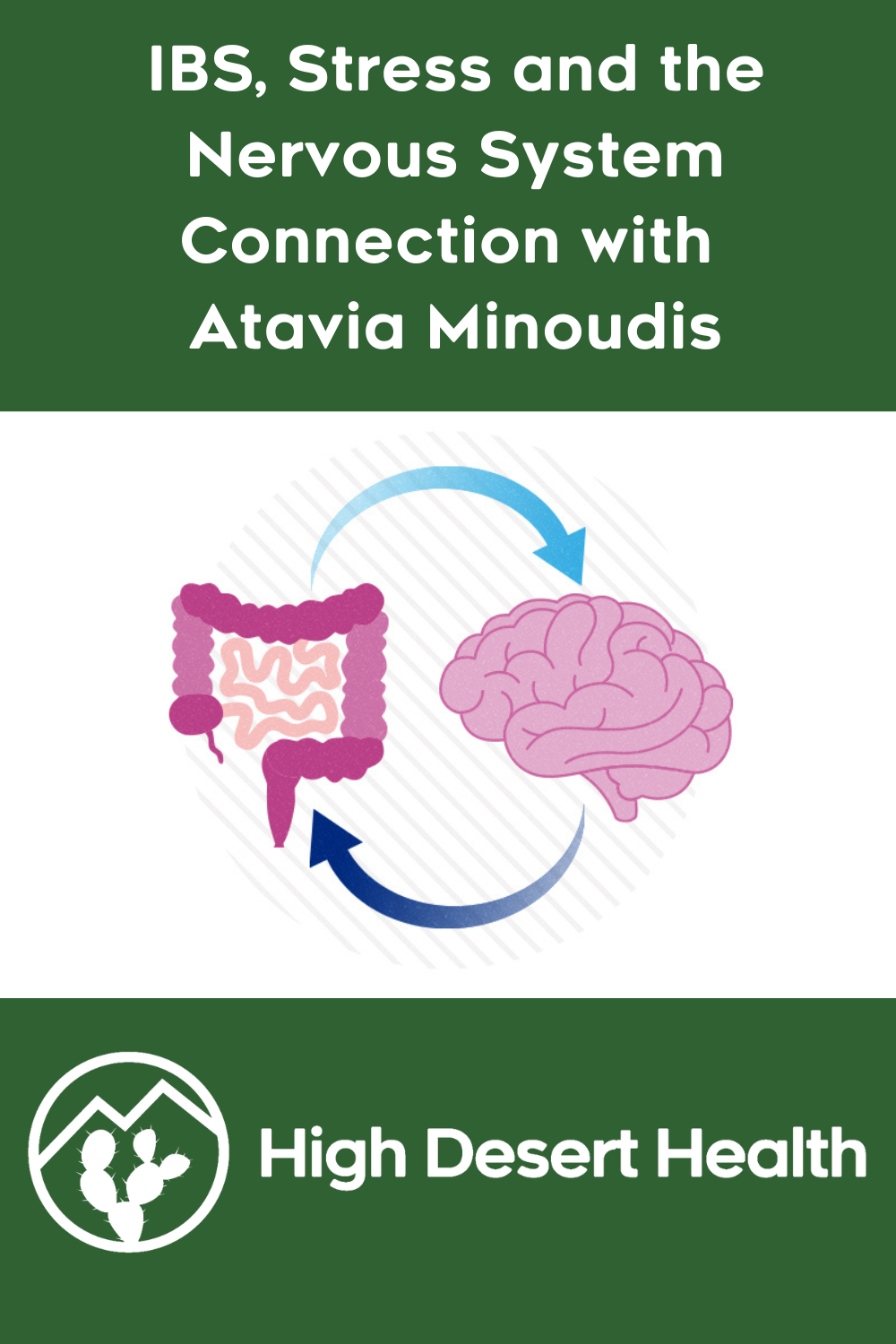
Adapted from episode 159 of The Perfect Stool podcast and edited for readability with Nutritional Therapist and host of the Gut Reactions Podcast, Atavia Minoudis and Lindsey Parsons, EdD.
Lindsey:
So in our intro conversation, we realized that while we both work a lot with IBS, I tend to focus first on the nitty gritty of gut bacteria and how things may have gone wrong physically, whereas your first focus is on the mental side of it. So I’m wondering how you landed at that place?
Atavia Minoudis:
Yeah, definitely. That was a very, very funny conversation where two people can specialize in the same thing but have completely different specialties. With me, I would say it’s because I have a background in psychology and counseling, and that’s where my training was before getting into nutritional therapy. I think I naturally attracted clients who have a lot of stress, a lot of anxiety and a lot of trauma.
So every time I was working with clients, I noticed that the nutritional input, like probiotics, and looking at gut microbiomes, would only get them so far, and then they’d kind of hit a brick wall, where their symptoms would improve, but then it would stop. The improvement wouldn’t continue. It would just kind of stagnate. And through working with those clients, we kind of realized that the symptoms only started to improve when we focused on their nervous system, and not just the stress, anxiety or the trauma response in their body in general, but also the mental impact that IBS was having. Because usually I’d see clients who are really highly stressed and have no idea, by the way; they wouldn’t even describe themselves as stressed. They think they’re just totally cool. But then the fact that they were having such difficult symptoms, even things like acid reflux or diarrhea or pain would make them more stressed, and then that would just continue the cycle. So that’s really how I landed at that place, unintentionally attracting those kinds of clients to me, and then seeing that people only made so much progress without the input of the nervous system and mental impact of IBS.
Lindsey:
Okay, so how does the vagus nerve play into the mental side of IBS?
Atavia Minoudis:
So when it comes to vagus nerve, I like to try and keep this more simplistic for people, because there’s so much information around the vagus nerve and nervous system, and it can kind of feel overwhelming, which ironically makes it worse. So what I would say to anyone listening is, most people are in a state of stress all the time. And when I say this, people are like, oh, I don’t have any stress in my life and feel fine. Just assess: you’re either in a state of stress or you’re in a state of calm and relaxation. So I asked my clients, when was the last time you felt tranquil and calm and almost like you’re high because you feel so, so calm, and they’re like, “Oh, I can’t remember.” Then you’re in a state of stress. Might not be super high stress, but it is a level of it.
So when you’re in a state of stress, your vagus nerve, which regulates the calm response in your body, it gets shut off, and it can’t do its job by calming all of the organs that it’s regulating, so your heart, your lungs, your gut, all those really important parts of your body. If you’re just in a state of stress, the vagus nerve can’t do its job to calm that down, and you’ll be reflecting the level of stress that you’re feeling in those different parts of your body. For our clients, obviously it ends up being the gut. So if you’re in a state of stress and tension, it then can increase IBS flare ups by shutting down digestion, or indigestion, causing cramping, inflammation, makes things like loose stools worse, all that kind of stuff.
So really, we want to switch on the vagus nerve to not only calm down your nervous system, but also to your question about, how does it play a role in the mental side of IBS, if you are in a state of stress, any kind of symptoms that you have, or any any thoughts about symptoms or flare ups that you have make you feel more stressed and anxious, which then just continues that cycle of then your symptoms getting worse. So if you’re able to calm your nervous system, it turns off the fight/flight response, so that you can start to see things more clearly. You don’t have those racing thoughts, the stress of like, “oh my God, when is this flare up over going to end? What is it this time?” All the panic thinking that you get when you have flare ups, or when you’re worrying about flare ups if you’re in the opposite of that and your vagus nerve is keeping you calm. It’s not just regulating your digestion and making that better, it’s also meaning that you’re able to look at things rationally, objectively, and you’re not having those panicking thoughts. So you end up having a better relationship with your gut and your IBS, rather than stressing about it and then it feels like the world’s going to end, because your gut is your enemy, essentially.
Lindsey:
And so how can you tell if the vagus nerve’s dysfunctioning, or are you just assuming if someone stressed that it is dysfunctioning?
Atavia Minoudis:
Yeah. So what I like to say to people is just to keep it as simple as possible. Just think of it as a light switch. So if your stress response is on, then your vagus nerve isn’t going to be on. So you want to switch the stress off, to turn the vagus nerve on, to allow it to function. So we go really based on your level of stress, and your symptoms can give a good indication of that, because for some people, they may not identify with emotional stress, but they’re putting their body under a lot of physical stress with high training. I work with people who’ve done triathlons, running a lot of the time, and then they develop what’s known as the runners runs, like where you literally get the runs from running so much. So looking at the type of stress that your body’s under, or the type of relaxation your body is experiencing is usually a good way to look at it, because when you ask people that question, they tend to think, yeah, I’m not usually that relaxed ever. So essentially, yes, looking at are you stressed. If you are, then your vagus nerve is probably not able to do its job and isn’t active.
Lindsey:
And so what can you do to modulate the functioning of the vagus nerve or to bring down stress?
Atavia Minoudis:
I would first look at how relaxed you are, how often. So if we take the example of, I like to say to people, imagine you’re on a beach in Thailand, or it can be any beach, but you’re so relaxed just lying on the sand, you feel like almost that feeling of just complete lightness in your whole body. You almost feel like, I say high, because you’re so so relaxed, like you’ve had a magnesium salt bath. When was the last time you felt like that? If you haven’t felt like that in a while, then you’re stressed. So what we need to do is focus on bringing that feeling more because that’s going to indicate that your vagus nerve is functioning.
And what I like to say to people is imagine it like a muscle as well. So you want to look at the vagal tone, because your vagus nerve has a tonality. So if you’re trying to tone up your bicep in the gym, you don’t just do weights once; you need to continually do actions like bicep curls to make that bicep grow. So in terms of how to activate and modulate the functioning of the vagus nerve, if you want to look at some things you can literally, practically do day by day, there are loads of things that you can try. Some things are like having an ice bath on your face. I would just say, stay clear of anything that’s too extreme. Just literally look at how often you’re relaxing throughout the day. Simple things like deep breathing, some actions that can literally turn on your vagus nerve are things like downward dog in yoga, because the muscles in your neck are connected to the vagus nerve. So when you’re in that pose, it turns on the vagus nerve. So downward dog a couple of times a day, you’re on to a winner. Or things like singing, humming, anything that activates the vocal cords, because that’s where your vagus nerve is, it starts in your brainstem, down into your body. Anything like that can activate the vagus nerve, and the more that you do that, the more that you’re going to build up that vagal tone. So over time, you can be someone who’s stress response is really quick. You have an email from your boss, and that light switch is immediately switched on, and you’re stressed. Or you’re super jumpy, like you can’t watch horror films because you just jump really quickly. Or someone walks around the corner and you jump. That indicates really poor vagal tone, and that is weak, but that your tendency is to go into the stress response. Over time, the more you work on your vagus nerve, you will notice that you still have stress thoughts, maybe if you get an email from your boss, but you don’t have that body response, or you can watch jumpy films without jumping so much you’re not so reactive. That shows that your vagus tone is stronger. So, yeah, my favorite way to do it is singing. Cold showers are good for some people and downward dogs as well.
Lindsey:
Okay, so you mentioned deep breathing, and I’ve always learned that it is important when you have any kind of breathing technique, if you want to get more into the parasympathetic mode, that you have a longer exhale. Is there any particular breathing that you recommend?
Atavia Minoudis:
Yeah, definitely. With deep breathing, I tend to look more at progressive muscle relaxation, which I’ll talk about in a minute. But with deep breathing, basically what your breath does is tell your body what state you’re in. So a lot of people, we’ve been conditioned to think it’s brain first and then body next. But actually there’s now research that shows your heart responds to stimuli experiences, and your breath responds first, because we don’t have time to register it cognitively in our brain i.e, if we were living way back when there were cave people, we see a predator, we wouldn’t have time to register, oh, that’s a predator. It’s going to eat me. It’s a lion. We would just immediately have that response in our limbic system, in our brain, that triggers our breath to become really short and shallow, and that tells your body then, oh, there’s danger. I need to do something about that. There’s stress.
So with breathing, I like to just start with breathing, in for four seconds, hold for four seconds, exhale for six and then if that doesn’t feel like it’s doing enough, or you feel like you could go longer, you can elongate those so you can I think for me, I generally do 7-7-9, so breathe in for seven seconds, hold it for seven seconds, and then out for nine seconds. But the key really is breathing so it’s telling your body, oh, I’m breathing slowly. I’m breathing mindfully and calmly. That must mean I’m relaxed. And then it tells your brain, oh, now you can relax. You can turn on the vagus nerve, just being mindful of really purposely letting that exhale out really slowly and really engaging with that feeling of calm as you do it, that’s really the key in terms of it being the exhale being longer. So, that would be my recommendation.
Lindsey:
Okay, and so were you going to talk about other mind-body techniques that you like for people who are stressed out?
Atavia Minoudis:
So I said I’ll talk about progressive muscle relaxation. What I would say to anyone before they start trying to do these things is just to engage in a body scan and make that a habit. So most of us are in a stress state, I say all the time, because that’s just how the modern world is designed – to keep us in a state of stress. Starting to try and shift that can feel a little bit alien, a little bit difficult. But if you start to recognize where you’re holding the stress, that’s really the first step, because you can’t heal what you can’t feel, right? So having an internal body scan is the first best step. And what I mean by that is literally, if you want to sit and close your eyes and do it, great, you can do it when you’re just walking around or just sitting at your computer. You don’t have to do anything specific, just in your mind, scan and notice all the different areas of your body, your shoulders, your chest, your belly, your legs, your jaw, is quite a common one. And notice how relaxed they feel. Notice where you’re holding tension. Once you have that level of awareness, that’s when you can then move into, oh, yeah, I do have stress.
Okay, so I need to rather than just rushing straight into trying to do deep breathing, you really want to be super aware that you are holding stress in the first place, because that’s going to help you to engage in the practices to calm it down. And then, once you’ve done that body scan, and actually make that part of your day, do it in the morning, do it at lunch, and do it at night time. And then the more you do that, the more you’ll start to intuitively think to do it throughout the day when you’re stressed.
But once you’ve mastered that art, I would say progressive muscle relaxation is a really good and active way to release tension. And don’t quote me on this, but I’m pretty sure I saw something that said the Navy seals use this when they’re trying to sleep in crazy places, and they can’t relax because obviously they’re out in the jungle somewhere. So if that’s true, then it’s good. It’s verified. But with progressive muscle relaxation, essentially what you do is you tend to start with your feet, and you work up every muscle group, up to your face. So it progressively relaxes your muscles. And what you do before you relax them is you tense them. So if you’re struggling to sleep at night, this is a great one. So you’re lying in bed, you would tense the muscles in your feet and scrunch your toes up and your feet really, really tightly. Obviously not if you have any injuries, but as tight as you can for a couple of seconds, hold it and then release it. And then once you’ve released it, you will notice how much tension you were holding beforehand, because it really highlights that tension and brings as much tension as possible by squeezing the muscles and then releases it. When you’ve done the feet, you move up to calves, then you move up to thighs, and you move up to every single muscle group until you kind of scrunch up your face in a really weird, really weird way and really tense your face muscles and then relax. And I’ve never had anyone do that where they haven’t noticed a difference afterwards, like you just notice how much tension you would have been feeling before, and how relaxed you then feel. And again, that indicates to your body, because you’ve tensed and relaxed it, that it can calm down, and it can shift into a resting state.
Lindsey:
Yeah, I have used that many times to try and fall asleep. I usually go through every one, but then I do my entire body at the same time, because that last one is so exhausting having to squeeze every muscle that it just creates a tiredness in you. So it definitely works for falling asleep when I’m desperate and everything else has failed.
Atavia Minoudis:
Yeah, same. And sometimes I’m lying in bed, if I wake up and I think, Oh, I can’t be bothered to do it. I’m like, come on. It’s not terrible, but it does really tire you out. But I guess that’s the point, right? But, yeah, it’s really useful. If you’re just anywhere feeling stress, you can do it – maybe not with your face, because you might look a bit weird if you’re in a meeting or something, but it’s a great one to use in general. Squeeze your feet.
Lindsey:
Squeeze your feet.
Atavia Minoudis:
Yeah, squeeze your feet.
Lindsey:
So you mentioned, as we started talking, that you think people don’t realize they’re stressed out. So you know like right now I’d say I probably feel pretty relaxed. How could you tell me I’m actually stressed?
Atavia Minoudis:
What I would say is, I would go back to how tranquil do you feel on a scale of 0 to 10, 0 being absolute tranquil, not a single level of tension in your body. Not a single muscle is tense. And then I would ask you to reflect on that, because if you think about it, stress is an adaptive response, right? We have to have some level of stress to be motivated to do anything. So if you’ve ever known anyone who’s had cortisol depletion, where they’ve literally flatlined, they have no cortisol, they have no stress hormones in their body – they can’t do anything. They are literally exhausted because cortisol is what we need, which is the stress hormone to motivate us to get up and turn off the alarm, get up and take a shower, all those kinds of things. So everyone has some level of stress constantly. We are both right now, just having this conversation, tensing certain muscles. We’ll be thinking just to get us to engage with each other. But the issue is, we should have a baseline of tranquility, and then up to 10 like major stress, probably verging on panic attack. Most people’s baseline norm has become a three or a four, sometimes even a five, because of the way that modern life is set up. So literally, just having a WhatsApp notification on your phone or your doorbell ringing, or just thinking about you have to go and pick up your kids later or cook dinner, all of those things are triggering a cortisol response, a cortisol release and a stress response in you, so that you’re in a state of stress consistently – doesn’t have to be a huge stress. It doesn’t mean you are facing anything majorly stressful in your life. It is just all of those little things, but they all add up, so that’s what I would recommend people think about. When was the last time you were super tranquil, like you’re sitting in a forest, bathing in a forest with not a care in the world. Most people say not in a long time that they felt like that.
Lindsey:
Yeah, no, the funny thing is, I’ll ask, when I interview new clients, I’ll say on a scale of one to 10, how stressed are you these days? And a good answer is usually like a five, like a five is you’re not struggling at all with stress. And then some people are like, more than 10, you know, 11, but, but seven, very, very common response. So most people do realize they’re under a lot of stress.
Atavia Minoudis:
And those people who realize it, it’s great, but it’s also very subjective, because stress means different things to different people, and I notice in different types of clients, usually, when I work with men, they tend to report low stress. Women tend to be a lot more aware that they’re feeling stressed. But it’s really important to know what your understanding of stress is. Because I could be thinking of something completely different from somebody else and that’s kind of what I found in my clinic, was people were taking that to mean, do you have trauma that’s happening in your life? Are you running out of money? Like, are there actual, specific environmental stresses? But actually, it’s just the biological reaction in your body. But it sounds good that you have very self-aware clients who come to see you.
Lindsey:
Well, I think some people will respond, I’m just a go, go, go, kind of person, like I’m a type A, so they know that they feel their stress all day long. Other people will say, “Yeah, I’m going through a really tough time with some issue in my life. Yeah. So it’s a 10 right now, but normally I’m more at whatever . . .” That’s the kind of responses I get usually. But I don’t know if they are thinking about that sort of constant, all day long, but yeah, I know the feeling you’re describing, which is this complete tranquility. Because I meditate every morning, and some mornings, my head’s just all over the place, and I’m not at all listening to what the meditation is saying. It’s always a verbal one, because that helps me to not be in my head quite as much. And then some days I’m just like, oh, this was just bliss, like I just felt so relaxed and wonderful. So I know the difference, the difference between a meditation that really worked and one where I was just thinking about other stuff, trying to solve problems the whole time.
Atavia Minoudis:
And that’s why it’s so important to have practices like that where you’re literally practicing to be relaxed. And I always say to people, you can’t take for granted that if you’re not stressed, you’re relaxed, you won’t be, you’re just not feeling the stress. You’re just not realizing that you are stressed. But if you’re doing things like you are, with the meditation that is literally holding up a comparison right? This is how relaxation feels. Where am I on that scale? But most people go through life not really ever doing anything that highlights that. So they just think, Oh, I’m not stressed. But yeah, once you start to, like you say, engage in practices that are about mindfulness and calming down, you start to notice it a lot, a hell of a lot more when it’s not the case.
Lindsey:
Yeah, I think people and speaking of meditation, it’s something that took me a long time to actually get into the practice of doing in my life, despite having, years ago, taken a meditation or mindfulness class. And I think one thing that stops a lot of people is they are worried about their brain going in a million directions and that they can’t settle their brain. And you probably have more experience in this than I do. Any comment on that?
Atavia Minoudis:
When it comes to meditation, what I would say is, first of all, that would be like trying to go into the gym and lift 100 kgs like that. That’s not the point of meditation, just starting to do it and letting your mind do that. You’re kind of trying to get from where you are now to your ideal outcome, which might be like calm and tranquility, right? To expect you to be able to do that straight away in your first go is so unrealistic. It’s kind of like when I’ve had people who said they went to a yoga class and they’ll never go back because the instructor said, oh, you can’t even, like, arch your back in this place. That’s because your body isn’t able to do it yet. You’re teaching it to do that.
So with stress and with meditation, you’re literally practicing it to get better. Yeah, and I really like your suggestion of using a guided one as well, because a lot of people I work with are neurodivergent as well or have ADHD as I do so, to try and meditate without anything with ADHD, the brain is not going to work. But if that doesn’t work for you as well, there are different things that can work for some people, doing something active, like walking at a slow pace and just engaging in your environment, grounding, looking at the trees around you, noticing bird songs, being in nature, that’s an active way to relax, but it can really calm down your cortisol response and your stress response. Being in nature creates quite a big drop in cortisol.
So if you’re not someone who can sit still and do those mindfulness things or not yet, then you can still do something calming. Your environment is super, super powerful as well. I’d look at things like having calming salt lamps and diffusers and things like that, and a calming environment, rather than big, horrible, scary overhead lights and noisy, I don’t know, Rock Metal playing or something in the background, switch it to something a little bit more calming.
Lindsey:
So a lot of men, when I ask them if they do any kind of practice, like meditation or yoga, they will say, well, I exercise. What do you think about exercise as a stress reliever?
Atavia Minoudis:
I think it depends on the individual. I think a lot of people, and what I’ve noticed with men, they’re very active. They’re doers. They want to be doing something and show like I’ve done this. Look, this means that I’ve done the practice. But a lot of the time, it’s not about that exercise long term, it teaches your body to regulate cortisol, so it’s great. But what I’ve noticed is, if you engage in intense, especially high intensity workouts like running or, God forbid, things like high rocks and all that, I would just never be able to do, if it’s in high intensity, you need to tell your body to relax when it’s over, because otherwise you can just stay in that stress response. So having a transition period after the workout where you literally just sit, maybe you do some stretching, but literally 30 seconds, doesn’t have to take you long or go and have a magnesium salt bath, engage in some deeper breathing, telling your body that that intense period is over, is really important, because then you’re going to help your body shift from that fight flight response that it’s had when you’re working out, back to the calming response. And exercise is really good. It releases hormones that help us to relax and be calm. But I think sometimes there’s a danger of over-relying on high intensity exercise, thinking that means you’re relaxed, but actually you’ve just burned out your adrenals. And you’ve just burnt out rather than relaxed. You need to kind of have the ying and the yang together.
Lindsey:
So back to the topic of IBS. How do you shift your mindset when you’re in that loop of stress, to alleviate the stress that contributes to IBS and its symptoms when they are happening?
Atavia Minoudis:
So inevitably, you feel the stress about it absolutely and that’s why I always come back to the first thing is just noticing it. And I think a lot of people with IBS, I call it a trauma – it is a body-based trauma, because often your body is doing something you don’t understand, you don’t want it to do, and you can’t control, and that can be very traumatic to people. The first thing is to notice that stress, because if you don’t notice the stress, it’s going to take all the supplements you want. You can do all of these different things, but if you’re not noticing the stress and you’re not calming it down, you’re only going to get so far. So notice that the stress is there, and then what you can do is look at specific interventions to then calm that stress down.
So inside my Calm Gut Academy for IBS, which is like a membership program I have, there are specific psychological principles that I recommend people use to start to detach the emotion that they’re feeling. So for example, tools like cognitive behavioral therapy or Neuro Linguistic Programming, like looking at how your thoughts and your language around certain situations fuel that stress response, start to use those interventions and get used to implementing them into your life daily. And something that I really enjoy talking about and teaching people is the concept of emotional diffusion, where you essentially diffuse the emotion around any given situation, that can be your IBS, or it can be work, family, life, whatever it is, but the practice of looking at the emotion you’re feeling around it, and taking a step back and detaching the emotion from the situation, and seeing the situation as something separate.
Because a lot of the time, what we can do is, say your boss emails you and says you messed something up, and you’re a failure, and you’ve caused this and whatever. We then absorb that and become that problem and feel the emotions around it, whereas if we can just take a step back and mentally separate that problem is over there, and my response to it is going to be something different that helps to calm down the stress response. So just using tools like that, and in terms of IBS specifically, that can be really helpful, because a lot of people do feel stressed because of their symptoms, which, like we said, then just feeds more symptoms than if you can look at: how am I feeling about my IBS, I’m feeling very stressed about it. Why am I feeling stressed about it? Because I’m scared, or I’m fearful that I’ll never feel better. And then start to approach it with curiosity.
So I always say on my podcast, look at IBS with curiosity and an open mindset. So when you have a flare up, instead of, oh my God, why is this happening? What’s my body doing? What’s going on? See the data, and that’s it. So when you’re having a flare up, okay, I’m having a flare up, maybe loose stools and bloating came out of nowhere. Hasn’t happened for three weeks. I wonder why? I wonder what my body’s trying to tell me. And then you can literally do a timeline in your mind and say, right, what was different one hour ago, nothing specific, what was different four hours ago, and just go back in time, and usually you’ll be able to pinpoint, oh, yes, I drank this new protein shake, and I had a huge amount of it, and that probably bloated me out. Maybe I was intolerant to it, or last night, I was really stressed, and I ate really close to bedtime. So of course, my body’s not had time to digest it. That just really helps to take the information as data, diffuse the emotional response around it. It’s not a threat, it’s just a sign, and then it helps you to identify what the actual trigger was. And then, of course, that’s going to help you feel more safe and less stressed, because it’s like, oh, actually, that makes sense why its happening. Okay, how do I respond to that? Well, if it’s the fact that I’m stressed, then I’ll focus on calming down my nervous system. So yeah, that would be a couple of things I would recommend.
Lindsey:
So when I think about stress and nervousness, I think about the nervous stomach, the diarrhea and when you have butterflies before you’re going to do public speaking or that sort of thing. So I’m just curious whether this approach of treating IBS through the psychological approach works as well with people who are constipated as people who have like, loose stool and diarrhea?
Atavia Minoudis:
Yeah, that’s a really interesting question. And honestly, about 90% of the people who come to see me have diarrhea and loose stools rather than constipation. I have seen it work for constipation, where people are basically emotionally constipated as well. They’re keeping their emotions in and they’re very stressed, and that shut down their guts and their digestion, but their microbiome probably is just slightly different to someone maybe with the loose stools. But yes, it can work, but what I’ve noticed is that people tend to come and see me when they have loose stools and diarrhea. A lot of people had constipation before, but that’s quote, unquote easier. It’s not any more pleasant, but it’s quote unquote easy to just grin and bear, rather than someone who then suddenly gets loose stools, maybe incontinence diarrhea. That’s when people are like, “Oh my God, I don’t want to crap my pants in public!” I need to do something about this. So yeah, that’s kind of a big motivating factor for people to come and seek help. So yes, I’ve seen it work, but mainly I’ve seen people with loose stools.
Lindsey:
Yeah, yeah. I’m always curious why people make that transition. They’re like, I was constipated my entire life, and then all of a sudden, boom, now it’s diarrhea. But I think underneath, I mean, from my perspective, there is a dysbiosis that tips the scale. And I feel like my understanding of it is beginning to get to the point where I understand that it always starts with an overgrowth of, typically these gram-negative bacteria that then can increase to the point where then they start feeding the methane producers, which then creates constipation. So that’s a different transition, the opposite one.
Atavia Minoudis:
Yeah, and I’ve seen it with people as well, where they’ve been constipated most of their life, probably in most people, I’ve seen some kind of food intolerance, like lactose or gluten generally, but then they’ve not sought any help for that, that’s caused a dysbiosis. Obviously, if you’re not going to the toilet, you’re going to have major dysbiosis too, right? And then I’ve seen a lot of people who’ve done very intense exercise or had a lot of stress, and then it suddenly switched to diarrhea, and they don’t understand it either, because it is really confusing, how can you go through such extremes?
But it’s really important to look at your stress response when you’re trying to balance your microbiome, because 30 minutes of stress can change your microbiome levels. It has such a big impact. So imagine if you’ve had 30 years of stress and constipation, that stress has been drip feeding your microbiome, the cortisol, killing off certain bacteria, and then all of a sudden, you’ve got diarrhea. It’s almost like it reached a certain point where that switch was flipped from constipation to diarrhea, because the stress was driving it. But yeah, it’s super interesting to see how people’s symptoms change based on their environments as well.
Lindsey:
So can you tell us about your podcast and where people can find you?
Atavia Minoudis:
Yes, absolutely. So my podcast is called Gut Reactions: Overcome IBS. And it is a podcast for busy professionals with stress, anxiety or trauma, and it teaches you how your nervous system essentially is triggering your IBS symptoms so that you can start to reduce them. And a great episode, actually, to listen to, based on what we’ve spoken about, would be Why you’ll never overcome IBS if you’re ignoring your nervous system. We’ll put the link to that in the show notes, I’m sure, so people can check that out. So that’s my podcast, and I also have for people who are curious to know what might be the underlying driver of their IBS, I’ve created a quiz, so it’ll tell you one of four things: Is it mainly to do with stress? Is it something to do with microbiome? So you can take that quiz if you want to take that as well and see what might be driving your symptoms.
Lindsey:
So thank you so much for coming on and sharing with us. I think this is, as I said, since I’m always in the nitty gritty of the science and the physical stuff, I think it’s always good to periodically have someone on who brings me back to the idea that there’s a mental side to all this that needs to be addressed. So I appreciate that.
Atavia Minoudis:
Definitely. No, It’s great talking with you, and it’s great to swap knowledge and experience as well. And what I would say to anyone listening is just to notice the impact that it’s having mentally, because I do see that so much with people, that the impact it has on your social life, on your mental well being. Most people will never give IBS the time of day if you talk to them, because they just see it as like, “Oh, whatever.” They don’t understand, but you are dealing with a long-term health condition, so to just allow yourself to accept that and be like, “Oh, I am struggling with this. You know, it’s something that I need to practice kindness around.” And if anyone ever wants to talk about the mental health side of things or nervous system, you can always come and follow me on Instagram, and I’ll be happy to give you some of my top tips as well to manage that.
Lindsey:
Awesome. Well, thank you so much.
If you’re dealing with gut health issues of any type (diarrhea, constipation, bloating, SIBO, IMO, H2S SIBO/ISO, IBS, IBD, gastritis, GERD, H pylori, diverticulitis, candida, etc.) or have an autoimmune disease and need some help, I see individual clients to help them resolve their digestive issues or reverse autoimmune disease naturally, You’re welcome to set up a free, 30-minute breakthrough session to see if you’d like to work with me. I also have my own two products, Tributyrin-Max, which is particularly helpful for loose stool and diarrhea as it slows your motility and firms up your stool, and SBI powder, which is an all around gut pathogen binder, which is super safe and won’t harm beneficial bacteria, and is usually the first line of treatment I educate my clients about in order to avoid stronger antimicrobial herbs.

*Product and dispensary links are affiliate links for which I’ll receive a commission. Thanks for your support of the podcast by using these links. As an Amazon Associate, I earn from qualifying purchases.