

Adapted from episode 170 of The Perfect Stool podcast and edited for readability with Reed Davis, Double-Board Certified Holistic Health Practitioner (HHP), Doctor of Nutritional Therapy (DNT) and founder of Functional Diagnostic Nutrition® (FDN)*, and Lindsey Parsons, EdD.
Lindsey:
So, I had you on episode 115, and we focused on the effects of stress, sleep, and food sensitivities on the gut barrier and gut barrier function, but today we’re going to be talking about the new dietary guidelines. So, as somebody who deals with gut health issues and often suggests people try dramatically different diets given the current state of their gut, I’m curious what your 50-foot view is of the new dietary guidelines.
Reed Davis:
Diet is one of the most important epigenetic factors as far as affecting one’s health goes. We put that right up at the top of an all-natural, drug-free solution that is eating right, and so it’s about time they did something right.
Lindsey:
Definitely. So, what was your overall feeling about the new dietary guidelines?
Reed Davis:
I’m ecstatic. I mean, it’s not gone as far as it could, and it could always be improved. But the old dietary guidelines for Americans have, for the last number of years, decades, been completely upside down, and I think it’s largely because those who would put the guidelines out there, in this case, the Health and Human Services Secretary and the USDA, got together to reveal these things, and it’s better for Americans, it’s better for kids, it’s going to focus on more high-quality, nutrient-dense foods and things like that, like they say, “eat real food,” what a concept!
And so, I mean, you’ve been in this game a long time, right? How long have you known that that was right?
Lindsey:
Yeah. I don’t think that’s a big secret. It’s not that people don’t know they’re supposed to eat real food; they just really like processed food.
Reed Davis:
It’s true, and it’s going to take some new habit forming for some people. So many stories over the years of people, just about their entire health changes when they eat right for their bodies, for their genetics, and what we call metabolic types. So, I’m happy to break it down for you.
Lindsey:
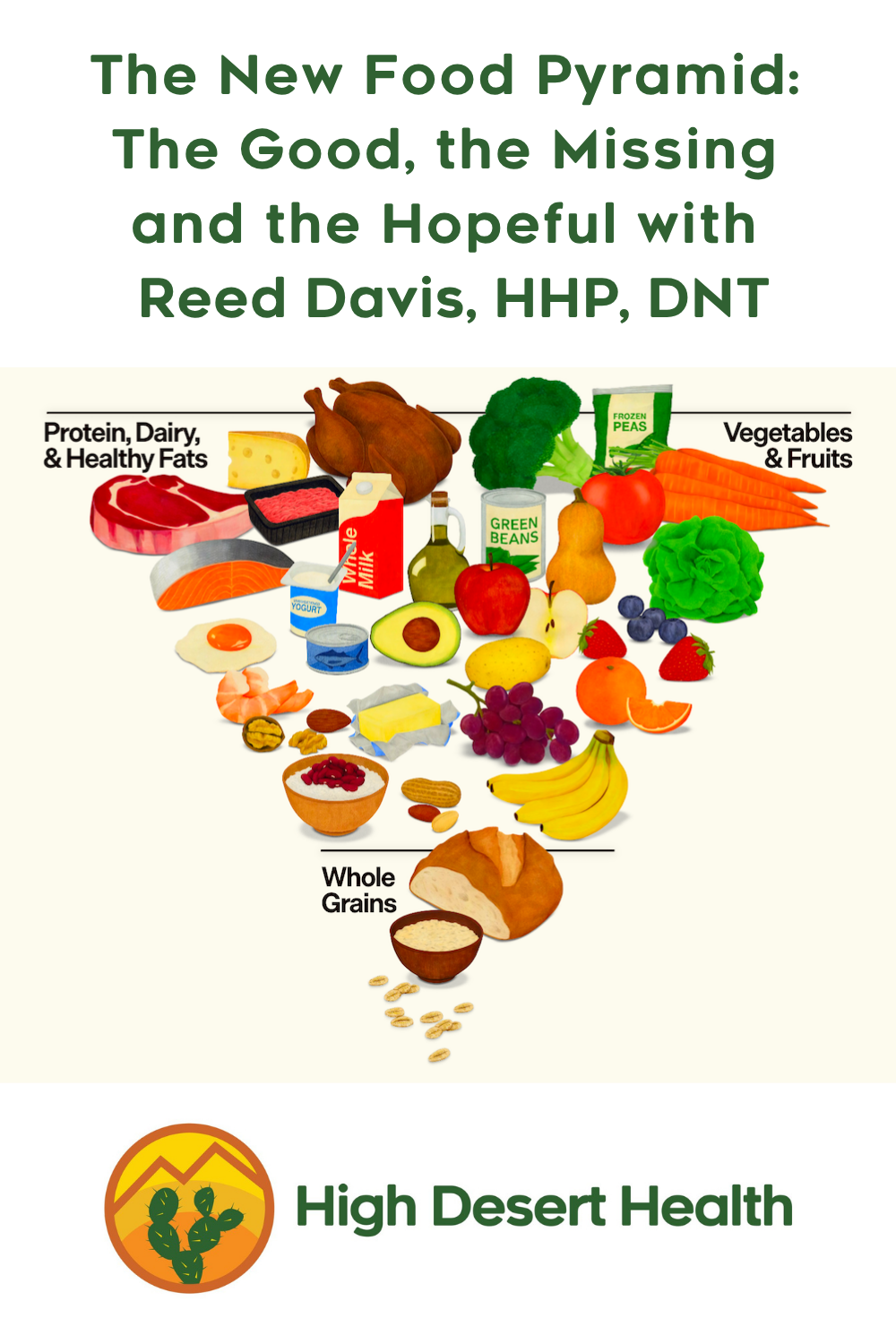
Yeah. Well, we’ll definitely get into those details. So, one of the biggest changes in the new dietary guidelines was demoting whole grains to the bottom of the pyramid, where they used to be at the top of the largest section. So, I’m curious if people were actually eating whole grains, as opposed to white flour and white potatoes and white rice, do you think that would have been a necessary step anyway?
Reed Davis:
Yeah. Even the so-called healthy breads and things like that, and pastas, if there was such a thing, would be too much, and not enough protein and fat. So, absolutely, it was upside down. And the results are what you get in America.
I have a friend, Tom O’Brien, he’s really famous for some books on health and things like that, and he says that out of the top 30 civilized countries, America, in terms of health, was ranked number two from the bottom. We’re one of the most unhealthy countries out of civilized countries, and it’s because of diet, because of who’s been in charge of recommending diets, and I don’t mind saying that it’s those who would have monopolies and sell what’s good for their company’s bottom line, not what’s good for our kids to eat.
And I’ve got story after story, if you’re interested in me telling a couple, but yeah, I want to make sure we answer that thing, that there’s people who do perfectly well in America, don’t eat any bread or grains, you know they’re not really required.
Lindsey:
I’m aware, of course, of things like the Paleo diet, where you’re not eating grains or even legumes. Is that accurate for paleo? Right, you’re pretty much just eating vegetables, fibrous vegetables. So but I do find that when I look at people’s diets, that it’s very hard for people to get enough fiber if they’re not eating some grains. Unless you’re a very, very purposeful paleo person, and you’re getting those winter squashes and those sweet potatoes every day, or those kinds of things, that the typical person who’s not super diet focused, that it’s hard to get the quantity of fiber that we really need.
Reed Davis:
Yeah, definitely. Fiber is still a big thing, and you can’t eat just meat. No one says, “just eat meat,” in my world. There’s the Paleo diet, and there’s even diets that do focus on that, but I think they still get their fiber, though, because they always would sort of, if you’re on an all-meat diet, the carnivore diet, they call it, they still cheat and eat fiber, or they’re going to get digestive problems if they don’t. So, it’s really important to get the fiber, of course, and I prefer the green stuff, vegetables, and roughage as my mother used to call it, “got to have your roughage.”
Lindsey:
Yeah.
Reed Davis:
Because the Italians would call it antipasti, and these kinds of things. So, you’re definitely going to throw a bunch of that in there, and that’s way up in the pyramid. Well, the biggest, the big picture that changed is that the top, which is also the biggest section, is protein, dairy, healthy fats, alongside your vegetables, and some fruits, which there’s some nuances in that. The bottom section, which is now the smallest, your whole grain.
Lindsey:
Right.
Reed Davis:
So, yes, some would be okay. I have a little bit of the wheat-free, gluten-free toast sometimes around breakfast. It gets me some of the fiber that I’m looking for. I put a lot of protein with it, but definitely you’ve got to have, you made a good point.
Lindsey:
Yeah, I mean, it’s one of these things that in theory it would be great if everybody just ate vegetables, beans, lentils, that kind of thing to get all their fiber, but that’s just not how people eat. So, the inclusion of whole grains is important for the average person. Anyway, that’s my opinion.
But thinking about that, the grain question for somebody with a family tendency towards increasing blood sugar as they age, not necessarily somebody who’s pre-diabetic, what amount of actual grains, meaning things like whole grains, like brown rice or quinoa, or brown rice pasta, or whole grain flours, or whole wheat bread, if you tolerate wheat, do you think is a safe amount for an adult man or woman to consume without running into blood sugar issues?
Reed Davis:
Well, everyone’s different. So, what I recommend overall, before we even get to the food pyramid, is that people look at the amount of protein, fat, and carbohydrates on their plate in each meal, and make sure it’s balanced for their, let’s call it oxidative rates, for the way they burn fuel.
So, people burn fuel, some burn it faster than others. It’s just the way you’re born. You have your fast fuel burners, we call them fast oxidizers, and traditionally you think of native tribes, they can be one way or the other.
I have a cousin that lived up north with the Cree Indians. They’re almost Eskimos, very, very fast oxidizers. If they didn’t eat all fish and game that they were eating for tens of thousands of years, or at least 1000s and 1000s, they would get sick. Since they switched to Westernized food, they got sick, they all got obese, diabetes, pre-diabetes, and they also got depressed, became alcoholics, and have the highest suicide rate in all of Canada.
The Cree Indians, and it’s because, genetically speaking, they’re supposed to be eating fish and game, which is plentiful up there still, by the way, plenty of caribou and all kinds of fish and things, but when the Westerners came in, they brought with them, by the way, for mining gold mines, copper mines, they brought in their food with them, fast food. So, if you’re a Cree Indian and you’re eating Tim Horton doughnuts, that would be the same for any fast oxidizer, you get sick if you eat too much of the breads and things like that, especially when it gets really highly processed, the more processed the worse, and it’s really, really unhealthy.
Not to say there aren’t tribes in the world, like the Quechua Indians come to mind from South America. They live their entire lives above 8,000 feet in the mountains, and they eat corn and potatoes. Those things are very abundant there, and if you’ve eaten them for thousands and thousands of years, then they’re perfectly fine. Your body has adapted to that kind of diet.
It goes much deeper than what I’m telling you, even in terms of the minerals and things that are in the soils and stuff. So, you need what you’re born to eat. The problem is, we’re all mixed, and no one knows what they’re born to eat. That’s something that we help people figure out, but it’s really important, and the current administration figured out we’re really unhealthy. Well, let’s look at what we’re eating, and oh, it’s a bunch of junk, it’s literally an upside-down pyramid. So, they flipped it on its head, and we’ll see what shakes out. I’m very hopeful.
Lindsey:
Yeah, so clearly there are people, indigenous people in Australia, also in the same scenario. They came in and fed them a bunch of flour and cooking oil, and the fried bread, and those kinds of things, and they all got super sick and diabetic.
But yeah, most of us are some sort of mix of some amount of European or some amount of Asian, or Latin American, or in the US, or African American, so we’re all a mix of this country. So, what you were talking about, the fast oxidizer, these are based on HTMA, hair tissue mineral analysis, or?
Reed Davis:
One way to do it is an online test, people go to MTDiet, they take a test there. It’s a lot of questions about dietary habits, physical characteristics, and even psychological traits, because there’s other elements of getting the right diet, and so they don’t have to do any testing.
There’s some other discussion about HTMAs and how close does it get to true oxidation. You can always do it and eat that way and see what shakes out. You should have more energy. You should have a higher sense of satiation. You should feel well fed. Oh boy, what a great meal, I’ve got lots of energy, I can make it till my next meal without snacking. Your cravings go away, and you even have a sense of well-being in some respect.
So you feel fully satisfied, nothing was missing, you have lots of energy to work or play, whatever it is, to get to the next fuel stop. And then, of course, some sense of well-being would be icing on the cake, and an actually very appropriate, well-fed person, fully satisfied, not craving anything, should be happy. If you’re not happy, go soak your head. I’m kidding. I’m just saying, you need to work on that. There might be some other reason.
Lindsey:
Yeah. You said that website was MT Diet, like mtdiet.com?
Reed Davis:
Mtdiet.com, it’s really, it’s very scientific. It’s been around for 40 to 50 years now, and we’ve just been using that as a guideline. It won’t tell you exactly what your percentages are, but it would tell you if you’re fast, slow, or somewhere in between, what we would call a mixed oxidizer, in which case you just adjust the proportions of your macronutrients on the plate.
If it’s me, I’m a very fast oxidizer, so I can eat a lot of protein in every meal, and as long as you don’t – you have to eat clean, and there’s all kinds of other factors, but a lot of protein, and the protein I like already has fat built into it, so that because I eat meat, and so whether it’s salmon or whatever it is, I don’t eat chicken, but a lot of really good, high-quality meats, and so I get my protein and my fat from that, and then I will also add the right amount of carbohydrates, usually very nutrient dense.
I love dark green vegetables, and I can eat a lot of them. And if you do that, you’ll find, let’s say, you did that for breakfast tomorrow, some people just don’t eat enough protein and fat in the morning, and so they’re craving, and they’re drinking a lot of coffee, and by lunch, then they overdo it at lunch, different things can happen.
But if you do it right, you will have, again, the three criteria are lots of energy, satiation, for sure, you’re not missing anything, you’re not craving, and then, of course, the sense of well-being, I try to be happy every day, no matter what, but eating sure makes a difference. You’ve heard the word “hangry,” right?
Lindsey:
I have.
Reed Davis:
You’re hangry, because you’re not nourished, right? You’re just something’s missing, and it isn’t just low blood sugar all the time. It also has to do with what your body really needs, and so the macronutrient ratios are really important. That’s what’s missing from the food pyramid. They don’t say anything about how much protein, how much carbohydrates, how much fats.
Lindsey:
Right.
Reed Davis:
That’s a place it could go eventually, maybe, but at least it got protein and fat up at the top of the list.
Lindsey:
Yeah.
Reed Davis:
For these kids, kids are just at the mercy of advertising and eating garbage. It’s what’s convenient. No one wants to take the time to prepare meals.
When I’m cooking on the grill, I grill enough for two, or even three days sometimes, so my leftovers are good as the meal, and I can eat them for breakfast, lunch and dinner, because it’s the same ratio. Try it, everybody should try it. Get out a ratio that feels good and eat that every meal. Don’t say, “well, for lunch I’m just going to have a salad.” If you’re a fast oxidizer, you’ll end up craving and hungry again.
You think of those Indians, my cousin was a priest, and he went up north, like really far. And I asked him one day about what do the people do there when they get sick? Do they go to see a medicine man? And he goes, well, I’m their “medicine man,” because he’s their priest.
I said, no, if they get sick, like the flu or something, he goes, oh man, they’re all sick, they’re all sick because they quit eating their native diet. Period. Obesity and diabetes and alcoholism, he said, were the most common things, and then that can lead to really bad social behavior, and so on.
Lindsey:
Yeah. So, you mentioned the fast oxidizers should be eating more protein or healthy fats. What about a slow oxidizer?
Reed Davis:
What’s the opposite? That’s again the Quechua Indians down in South America, and there’s many more with that kind of bloodline.
Now we have to go back to get to the original. You probably have to go back 500 generations. Well, no one can track that far back. You have two parents, you didn’t have a choice. You have four grandparents, you have eight great grandparents, and 16 great-great-parents. Now go back 500 times that and look at the top of that pyramid, but it’s a couple of 1,000 people all contributing to your DNA, the nose on your face, the hair on your head, if you have any.
Yeah, and the diet, what’s the right diet for you? It’s bred in the bones. Now you can eat that way, or pay the piper, and look at how sick we are.
Lindsey:
Yeah.
Reed Davis:
We’re not eating that way. And so, can’t, it’s too hard nowadays, unless you’re tribal. If you’re a Quechua Indian, you could probably know a great, great, great, great, great, great granddaddy ate the same thing you’re eating.
If you’re healthy, you could go to the Bantu tribe in Africa,, very dark-skinned, very healthy people with straight white teeth, because they still eat what their great, great, great to the 40th power great grandparents ate. They eat the same thing, and it applies, not only, we’re not talking about the pyramid now, but kind of the concept, not only would that give you the right percentage of protein, fat, and carbs, but the right sources, some indigenous foods, what was available all those years ago, and then whatever was in the soils.
We have vitamins and minerals, we have a sense of fatty acids, we have antioxidants, we have trace elements, phytonutrients, and really important constituents and we’re designed to use them all. Our bodies don’t have to be taught anything, and so then you’d have the kind of the micronutrients that would also match your genetics. So, if you want to live through your genetic potential, be the best that you could be, then you have to eat like that, and you have to figure it out.
Lindsey:
I do these Pure Insight reports with people’s genes, and they do spit out some results, certain genes saying you’re going to do much better with a high protein diet, your glucose is going to be much better managed if you exercise regularly, or you have the genetics of an endurance athlete, or things like that seem to pop up a bit. I mean, it’s obviously not complete, but it’s a little bit of information that people get.
So, anyway, but yeah, people can go to that website and look at what their ideal diet might be based on what they answer, and let me move on to talking about fats a little bit. So, one of the stark changes of the new dietary guidelines is a change in the recommendations on fats. Can you describe what those changes are and what you think of them?
Reed Davis:
Yeah, sure. More fat would be more energy and better balance, but it’s not so much just fat as the type of fat. So, they’re recommending now, of course, very high-quality fats, and not the crappy oils that we’re being fed.
If you go to a hospital today and look at what’s on the menu, it’s atrocious, the amount of seed oils. My wife and I use, it’s called Seed Oil Scout, SOS, and Seed Oil Scout, it’s an app you can get on your phone, and it doesn’t have every restaurant, but you can go to it and it’ll let know where you are, with a GPS in there, and it’ll tell you the good restaurants that have, are pretty much seed-oil free.
Some restaurants are seed-oil-free. They’ll use only avocado and coconut, and maybe some tallow, and things like that. That’s a good kind of fat that really, your body knows what to do with that. When it comes to seed oils, not so much, you’re not, that’s not bred in your bones, and so when it comes to trans fats, we don’t even want to go there, they’re just toxic.
Lindsey:
Yeah.
Reed Davis:
And there’s other ways to break down oils, omega 3, 6, 9, omega three generally anti-inflammatory, omega six more inflammatory, so seed oils, mostly omega six, are inflammatory. So if you have joint pain, you’re bloated in your face, and you have aches and pains from inflammation, seed oils make it worse, guaranteed, that’s how it works.
So, I’m glad you mentioned fats. We’re up against what’s convenient, what’s cheap, what has a longer shelf life, things like that. It’s going to be a long time before, for instance, any fast-food restaurant starts using good oils, they use what’s cheap, what has the longest shelf life, which is trans fats, and even if they’re using seed oils, they’re using the wrong ones.
Lindsey:
Yeah.
Reed Davis:
Avocado is really good, coconut, those are both seeds, avocado seeds, and coconut is actually a seed, and what I’m saying.
Lindsey:
Right.
Reed Davis:
So, I think it’s really important, as I said originally, the right percentage of protein, fat, and carb, and the right sources. Very important.
Lindsey:
I deal with a lot of clients with hydrogen sulfide SIBO who react badly to saturated fat, and I also have seen a lot of gut tests from people on high fat and high saturated fat diets, like ketogenic diets, and honestly, their gut microbiomes are pretty terrible, like mostly dominated by pathogens and opportunistic pathogens. So, I’m just curious if you’ve seen the same thing.
Reed Davis:
Yeah. Again, you need the right kind of fats, and some are not only inflammatory in terms of the joints and muscles and other tissues, it would include the lining of the gut, and so there’s another thing that made the cut.
When it comes to, the gut made the cut, they mentioned in the new pyramid that considering the gut microbiome is really, really important, and the previous dietary guidelines never mentioned it. And we run tests, it’s what I do, I teach a course in functional lab testing, so we look at these mucosal barrier assessments, so that’s not news to us. In two and a half decades I’ve seen all kinds of gut dysfunction, and everything that can turn into, which is worse, and helps correct it using the right diet.
Just not even a question, you can live yourself out of whatever you’ve lived yourself into, if you have time and dedication, if it hasn’t gone too far. There’s some people, I mean, they’ve gone so far as to really ruin receptor relationships, all these different things that are involved, the ability to digest, the ability to actually break down and absorb food properly, of course, once it gets in the body, how do you detoxify the body? All kinds of things come into it, but again, I’ve got concerns about the pyramid, but it’s definitely going in the right direction.
Not once do they mention testing, I think it’s a big mistake, or at least it’s an improvement that we’re still waiting for. They don’t mention food quality, they just say, they don’t mention organic versus conventional, big mistake, or at least again room for improvement. They don’t mention grass-fed versus grain-fed when it comes to meats, beef especially, that’s an area for improvement. They don’t mention wild-caught fish versus farm-raised fish, which is really, I think, incredibly important. So, these distinctions matter, the fatty acid profiles, for instance.
Horrible with farm-raised fish, and with grain-fed beef, and with conventional non-organic vegetables, the presence of pesticides and antibiotics, and that’s all yet to be widely distributed. I don’t see the government getting too involved.
Lindsey:
Yeah, definitely an improvement there. So, let’s talk about protein for a bit, so I listen to a whole variety of podcasts and hear a range of protein. What are the new guidelines saying? What would you recommend for minimum and maximum protein consumption?
Reed Davis:
With respect to metabolic typing and genetic requirements, I would say at least half of your plate should have some kind of protein and some fat, and then what would be really cool is if everyone would just start there.
If you’re not sure, we test, we go to mtdiet.com, we get, they give you the starting percentage wherever you start, because it’s 50/50 protein, fat, 50% carbs, all high quality, you’d want to use organic and all the things that we just mentioned, but well, you’d know from, you start to feel better, start to lose a few pounds, your brain fog would clear up, your cravings would go away, your sense of well-being may return tangentially.
If you then from that 50/50 start adjusting it up or even down, not too many Quechua Indians around here that could live just on potatoes and corn, but maybe you’ve got some slow, low oxidizer genes in you, but you would then go, odds are, you start at 50/50, then go up, go to 60/40 if it works even better, ah, you’re on to something. This is your own test.
If you go from there to 65/35, you might find you do even better. Boy, I really got a lot of energy. I can get all the way to my next meal with no snacking in between. My brain feels good, feeling good. You might try 70%. All these things would be adjusted, by the way, depending on the amount of activity. Work on a farm, you’re probably going to eat some more potatoes at nighttime. You need, you need that store of the carbs, but you get my point that it’s really an individual thing.
Their recommendation, the new HHS guidelines, which were backed up by the Food and Drug Administration, says something like one and a half grams of protein per kilo, so I don’t know why they use kilo, so for a 150-pound person you’d be looking at 85 grams of protein a day, or something like that.
Yeah, so we don’t use formulas like that, we use what it looks like on the plate, because it’s much easier. And then you can judge. We do give people, matter of fact, with that website I just gave, you would get your diet, some menu advice, you’d find out if you’re fast, slow, somewhere in between, and you would get the percentages.
They give you the percentages of each plate. They give you some diet check record sheets, which you can track, they’re just pieces of paper that have breakfast, lunch, dinner, and what you have, you write it in real quick. And then over on the right-hand side is how you feel, negative things like tired, unfulfilled, craving, cranky. Well, that wasn’t a very good meal for you, was it? But if you feel solid energy and the lack of cravings and sense of well-being, then, well, that was better, and you can actually fine-tune it. This is why health coaches are so important these days, in my opinion, they can help you, walk you through that stuff.
Lindsey:
Yeah.
Reed Davis:
What do you think about that?
Lindsey:
Yeah, no, I mean, I was always worried about getting enough protein, because I keep hearing these recommendations, like minimum, it’s like one gram per pound of body weight but then I heard something.
Reed Davis:
It’s a little more like it’s up to about 1.2 to 1.6, something like that.
Lindsey:
Yeah, I mean, I weigh 130 and I couldn’t even begin to eat 130 grams of protein in a day, like if I ate that much protein, I would be.
Reed Davis:
No, no, I’m sorry, it’s 1.2 to 1.6 per kilo, which is 2.2 pounds, yes.
Lindsey:
Right, okay, yeah, so it’s more like 0.7 to 1.0, or something like that, grams per pound of body weight. Yeah, I don’t know. I took somebody’s recommendation, and I think it came out to something like 90 grams, and I thought, no way, I’m even getting 90 grams of protein, because I might only have one meal with a really solid portion of protein, and maybe lunch is a little bit smaller, and breakfast is just like one egg, so that’s six grams, but I couldn’t even eat two eggs, and I just get stuffed and gross with what else I’m eating.
But anyway, I added it all up. I went into Cronometer, and I added it all up, and I was like, oh, I actually am getting 85 to 90 grams of protein a day. I was worried, because I wasn’t counting, there’s a little bit of protein in vegetables, there’s a little bit of protein in grains, it’s not like there’s none, it’s just a gram or two here, a gram or two there, it added up. So, I was okay, I was glad to see that.
Reed Davis:
How did you feel doing that? And how was your weight, and how was your mental clarity in things?
Lindsey:
Yeah, I mean, I don’t have issues with weight, I don’t have issues with mental clarity, but I have post-infectious IBS, so I don’t always feel great after eating, because there are periods where I’m having recurrent SIBO, and I bloat, so it’s not the kind of thing where I’m the best test case for anything diet-wise, but, but energy and all that, fine, yeah, no issues.
Reed Davis:
You might, you might be the perfect test case, because your body doesn’t have to be taught anything, every cell and tissue and organ knows what its job is. It just needs to be fed right, again, the macros, protein, fat, carbs, and the micros, vitamins, minerals, and essential fatty acids, antioxidants, trace elements, and so on, and it’ll know what to do.
So, but when we have, say, negative influences, whether it’s the environment or the way you think, or trauma, accidents, and things, bad things happen, you get out of balance, and demands are different, and then what you said about the grams, if you lean towards fast oxidizer, a few more grams of protein. If you lean towards slow oxidizer, it would make you sick, you wouldn’t feel well at all.
It’s like this, if you have a bonfire, a big fire, you’re a fast oxidizer, you’re burning up the fuel, you’re burning up the fuel, well, carbohydrates are like paper, you can’t throw paper on a bonfire, it’s gone. You throw big logs on a bonfire, and they burn for a long time, very solid, that would be protein and fat.
So, you look at those Eskimos, they’re super-fast oxidizers, you got to throw big logs on the fire, they can eat just blubber and some meat, and the only carbs they get would be seasonally, and they’d eat some of those, put on a little weight for the winter. If you just gave them, doesn’t matter how good the bowls of fruit and vegetables you gave them, they’d always be hungry.
And the same thing, those South American Andes natives, they couldn’t eat like that, they wouldn’t be able to move, they couldn’t burn it. They do well on paper diet, tubers, and corn, and low-hanging fruit, I guess, whatever. And milk, they do pretty, actually pretty good on goat and llama milk, and stuff like that.
Lindsey:
Yeah, let’s talk about milk and dairy, because as a gut health person, that’s one of the first things that I, gluten, dairy, those are the two most inflammatory, shall we say, or irritating to the gut, difficult to digest things, so a lot of the people I work with are dairy free.
I’m dairy free for the most part, because I’m lactose intolerant, and with recurrent SIBO, dairy is literally the worst thing I can eat, I feel bloated, and I feel terrible. But obviously, they’re high in the dietary guidelines, you can’t even get a school lunch without putting a thing of milk there. What do you think about dairy in terms of people with gut issues versus regular people who don’t have gut issues, and everything in between?
Reed Davis:
Well dairy, cow dairy for a lot of people is going to create a lot of mucus and problems, and so that’s besides the ones who are also lactose intolerant, which means they don’t have the lactase enzymes to break down the milk sugars, but milk can be irritating.
It has a protein called casein, it has fat, milk fat, and it has carbs as well, it has sugars, the lactose. So, there’s three different ways you can be eating wrong, despite how you handle that stuff.
I do agree with the new pyramid’s idea of higher fat content milk, because if you’re going to drink it, you might as well get something decent out of it for energy, so full fat dairy, not the low-fat junk we’ve been fed for decades. There’s nothing to say that’s any good for you whatsoever. That I accept. That doesn’t mean you can do unlimited saturated fats either. You don’t want to get more than a certain percentage of your calories, and again, the fast oxidizers could probably do 20% and slow oxidizers, less, maybe only 10%, but you got to have, so saturated fat, milk has plenty of it, it’s actually very nutritious for baby cows, so it can’t be all bad, right?
Lindsey:
Yeah no. I also get all mucousy with the dairy, and that is, yeah, the reason I had acid reflux until I stopped eating dairy. I mean, it was the single best thing I pulled out of my diet, but boy, it is really hard to go eat anywhere. Restaurants, so many dishes are, they’re like, oh, they’re so happy to market gluten-free, but every single dish has dairy, so, and that’s the worst thing for me, so it’s frustrating if you’re dairy free and react badly to it, because even, even with lactose enzymes. . .
Reed Davis:
Hard to go out.
Lindsey:
Yeah, it’s hard to go out, it’s hard to eat at anybody’s house. It’s just, yeah, it’s hard.
Reed Davis:
Well, more and more, the more we demand it from our food vendors, the more you’ll find it. There’s also some people who seem to do okay on the unprocessed, the unpasteurized.
Lindsey:
Raw milk.
Reed Davis:
That’s being sort of bandied about that it’s better for you, probably is, but I still don’t drink milk.
Lindsey:
Yeah, it didn’t make a lick of difference for my lactose intolerance, I’ll tell you that much, because I tried for a while. There’s all sorts of people out there claiming things like, oh, you drink raw milk, and you won’t have any problem digesting it. I’m like, yeah, no, not true.
Reed Davis:
Oh, that’s silly. Yeah, of course.
Lindsey:
Or “you eat yogurt, and that’s going to cure your lactose intolerance.” Also, no, that’s not a thing.
Reed Davis
Yeah, it’s hard for people because we do food sensitivity testing (can be ordered through Lindsey) as well. Pretty much every single client gets a food sensitivity test, because everyone has some. Everyone has some food sensitivity.
The question is, how much of those sensitivities are affecting your health? Are they contributing a lot to your dysfunction, or whatever it may be, or are they contributing a little? Well, we test everybody, and we find when they eliminate that food, that boy, that was the major contributor. We call it a contributor to metabolic chaos, and it’s really a valid term being used more and more often. What causes metabolic chaos, and all the downward spirals, and the cascade and resulting in dysfunction and disease and symptoms occurring, so food’s huge, and dairy is one of those that I don’t know too many people that it’s really good for, that just thrive on it, more dairy for that one, not in America.
Lindsey:
Yeah. So, I’ve been thrown, though, by the whole C15* coming out, because that’s a fat that’s mostly in dairy and some fish, and they’ve done all this research. It sounds like everybody’s supposed to have certain levels of it, healthy aging, the whole thing. So now I’m kind of like, are we supposed to be eating dairy fat? I’m okay with ghee, so I could get it that way without getting all the lactose and the casein and everything else. So, any thoughts on that?
Reed Davis:
Yeah, ghee, there’s people who use ghee, it’s clarified butter, so it doesn’t have the other, it’s just the fat, and I’d rather use tallow myself, which is what I cook often enough. Tallow and olive oil, some coconut oil, and avocado oil seem to agree with me pretty well.
Lindsey:
Yeah.
Reed Davis:
Although none of my ancestors knew what an avocado was, I don’t know how. I don’t know how that works.
Lindsey:
Yeah, have you heard of the Zero-Acre oil*?
Reed Davis:
What is it?
Lindsey:
It’s high in omega three. It’s produced by bacteria fermenting sugar into an oil that’s high in omega threes and doesn’t get badly affected by heat if you cook with it. I think it’s good to like 450 degrees.
Reed Davis:
Good temperature.
Lindsey:
They’re not using any land to create it, because they’re using bacteria to produce it.
Reed Davis:
Oh, I see. Yeah.
Lindsey:
Yeah, that’s something I use for high heat cooking if I need to.
Reed Davis:
Yeah, Zero Acre farms. I’ll look at it. Yep, I’m all for it.
I actually just invested in some transformation farms. You can buy conventional farms and turn them into organic farms. It takes three years, but the produce is so much higher quality, it sells more organic food, and is more expensive. It’s funny, because you’re getting less for your money, you’re not getting all those pesticides and herbicides and rodenticides and all the other things, but yeah, more expensive, much more creative ways to keep the bugs off, and these kinds of things. Yeah, so that’s really important, and so your health is pretty good, you would say, Lindsey, since you changed your diet?
Lindsey:
Oh, I mean, definitely better. Yeah, definitely better. I mean, it’s always a work in progress, but, yeah, no, I come up well on tests, for the most part.
Reed Davis:
Do you feel good?
Lindsey:
Yeah, I feel good. I mean, a familial tendency towards high cholesterol, familial hypercholesterolemia. So, yeah, I think I’m one of those people that doesn’t do so well with too much saturated fat. Also, I don’t know, gallbladder maybe doesn’t, doesn’t handle it so well. I tried the ketogenic diet once for like a month, and I started having pains, shooting pains in my body, so I was like, this isn’t good for me.
Reed Davis:
Yeah, well, I probably would recommend some lab work around liver function, and the gallbladder needs to flow very freely. You can’t have any congestion in your gallbladder.
Lindsey:
Yeah, no, I did a little kind of gallbladder cleanse thing.
Reed Davis:
Yeah, good. You don’t want to lose that.
Lindsey:
Yeah, no, I have no intention of losing my gallbladder.
Reed Davis:
You don’t get extra parts, do you?
Lindsey:
Don’t get extra parts, and some people think that that’s a disposable part, but definitely never seems to solve the problem when people get rid of it.
Reed Davis:
We had a patient many years ago, who said he came in, and he had some gallbladder digestion, and he said that he went to his GI guy, and they said, “oh, we’ll just take your gallbladder out, you don’t really need that anyway,” and ended up saying something like, “that’s our bread and butter diagnosis and treatment, gallbladder removal,” and it’s kind of insane. I mean, bread and butter, that’s how they make their money, is by taking them out. But we tried very hard to save his gallbladder, but he couldn’t maintain the discipline, he still wanted to eat wrong.
Lindsey:
Yeah.
Reed Davis:
So, he ended up paying the price.
Lindsey:
Yeah, I’ve just learned that I can’t eat things anymore like pork belly, like things that are super high saturated fat. That’s just going to make me feel absolutely miserable. So, I avoid those foods, but occasionally you do happen to find yourself eating a meal that was just way too high in saturated fat, and feel miserable.
Reed Davis:
Yeah, pork belly. Obviously, almost all fat, it would require a lot of digestive juices from the gallbladder, but the bile. Number one, if you really love the taste, you could probably take some ox bile with it and lipase.
Lindsey:
I could, but I don’t eat it that often. I’m not carrying around ox bile.
Reed Davis:
It’s not on everybody’s menu, for sure.
Lindsey:
No, but occasionally the restaurant looks good, and you’re like, oh, I’d order that, but I know I’m going to regret it.
Reed Davis:
Take your ox bile with you, and lipase, lipase is from the pancreas, they come together in the common duct before they go into the duodenum there to break down fat, and their signals when you eat fat, your body signals fat’s coming, and you’ll start to release the bile and the lipase, and you’ll be able to break it down. So, if you’re not doing that, you could end up with, it’s kind of easy to detect, they call it steatorrhea, which is light-colored stools that float, and you got to watch your fat.
Lindsey:
Yeah, what about light-colored stools that don’t float?
Reed Davis:
Yeah, I think the floatiness is maybe a better indicator, and that light colored could be something else, but that maybe there’s just enough going on there where they’re not floating, but the common symptom of poor fat digestion and breakdown would be the light-colored floating stools, it might not even be light, and other things would affect it.
These are the guidelines, those aren’t real tests. We have tests, we can do a stool test, we can do a urine test and figure out a lot of stuff that’s going on with people. We do saliva testing, of course, and blood work, all the things.
Lindsey:
What stool test do you like?
Reed Davis:
I like the old-fashioned ones where they actually had human beings looking at the stool, looking at it under a microscope, good microscopy, trichrome staining, antigen testing, and culturing. We had to have a person look at the kind of fuzz growing in the petri dish. They would do like seven or eight petri dishes per stool sample, and so it’s really hard and expensive to find that anymore.
So, everyone now is using DNA testing, the testing by PCR, which is all done by machines, and it’s accurate. It looks for parasites, bacteria, fungi, and viruses. It also does functional analysis, like elastase, and these kinds of things that would tell you functionally what might be off here and there, and that’s what people are using now, the GI map from Diagnostic Solutions Laboratory. It’s a good test, again, it’s not the old-fashioned way, but it’s fast, and it’s cheap, so people are using that, could tell you a lot, especially on the pathogen side. You could find people with some serious bugs, that’s not normal.
Lindsey:
Yeah, I’ve stopped using the GI map because I just find it doesn’t have as much information as some other tests, like I use Tiny Health Pro now, because they’ve got the full metagenomic sequencing, plus they have all the GI markers, and then the Gut Zoomer too. The Vibrant test has, like . . .
Reed Davis:
We do a lot of Zoomers.
Lindsey:
. . . so many more areas, yeah, and it has all the markers for gluten intolerance, and so many more inflammatory markers. It’s just so much more information now, so I think they just added neurotransmitters.
Reed Davis:
Yeah, that was called Tiny what?
Lindsey:
Tiny Health PRO. Yeah, I’ve been using them. They started with microbiome sequencing for babies and moms, and they have the full adult test. So, yeah, I like that, because you literally know the percentage of every bacteria in the gut, and how it’s breaking down, so it really gives you a good picture, like, yeah, maybe somebody’s overabundant in this particular species, but that is actually only 0.1% of their microbiome, as opposed to this thing that’s 13% of their microbiome, which is a whole different way of looking at it than the PCR, because you really know every single thing.
Reed Davis:
Yeah, well, thanks for that. Yeah, they do the vaginal microbiomes, yeah. So that’s, yeah, that’s great.
Lindsey:
Yeah, I like that one. Anyway, we’re running out of time, so tell people where they can find you and about the Functional Diagnostic Nutrition course.
Reed Davis:
Yeah. Let me, well, I teach this course called Functional Diagnostic Nutrition*. You’ve made it when you have your company’s initials on your shirt; that makes you important. So, let me look at my calendar to see if we made a special link just for your listeners.
Yes, so it’s fdntraining.com/perfectstool26*, and that’s in your honor. So, if your listeners and viewers would go there, we have a gift. It’s a free behind the scenes access to the lab methodology we do. It’s kind of cool. I don’t know what it’s worth, but it’s free and we won’t try to sell you anything. We just inform you, you make your own decisions about whatever you want to do. Thank you for recommending me to Zero Acre and to that Tiny Health, I have never heard of them, you just never know. I do see they do beta-glucuronidase too, that’s a good marker for, yeah. I’m happy to be here, Lindsey. Time sure went by fast.
Lindsey:
Nice to talk to you again.
Reed Davis:
That’s what happens when you’re having fun, right? Take care.
If you’re dealing with gut health issues of any type (diarrhea, constipation, bloating, SIBO, IMO, H2S SIBO/ISO, IBS, IBD, gastritis, GERD, H pylori, diverticulitis, candida, etc.) or have an autoimmune disease and need some help, I see individual clients to help them resolve their digestive issues or reverse autoimmune disease naturally, You’re welcome to set up a free, 30-minute breakthrough session to see if you’d like to work with me. I also have my own two products, Tributyrin-Max, which is particularly helpful for loose stool and diarrhea as it slows your motility and firms up your stool, and SBI powder, which is an all around gut pathogen binder, which is super safe and won’t harm beneficial bacteria, and is usually the first line of treatment I educate my clients about in order to avoid stronger antimicrobial herbs.

*Product and dispensary links are affiliate links for which I’ll receive a commission. Thanks for your support of the podcast by using these links. As an Amazon Associate, I earn from qualifying purchases.