

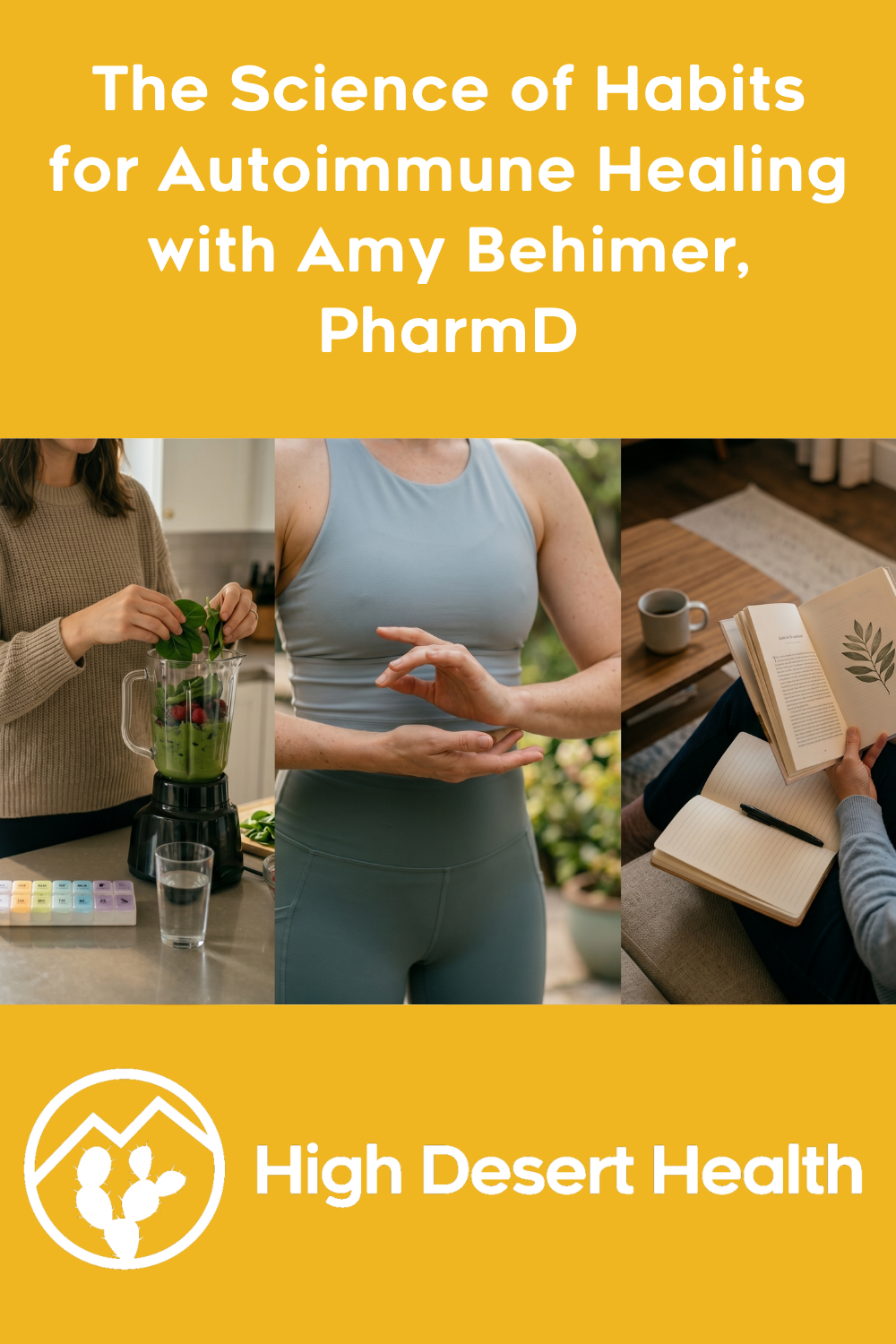
Adapted from episode 169 of The Perfect Stool podcast and edited for readability with Amy Behimer, PharmD, board-certified health and wellness coach and host of the podcast Autoimmune Health Secrets and Lindsey Parsons, EdD.
Lindsey: So, could you tell me about your journey with MS and where you are now?
Amy Behimer, PharmD: Absolutely, MS (multiple sclerosis), was my third autoimmune diagnosis. The first time I heard the word autoimmune, I was 17. I was in high school, and I started getting these white patches all over my skin, and I didn’t like the looks of it. I was a teenager, but didn’t think much of it. I went to pharmacy school, and I started to learn more about what was happening in the body, and how autoimmunity usually clusters, and if you have one, you have more. And so I started to think, oh goodness, was this skin condition just the first one?
And so next came a thyroid diagnosis, Grave’s disease, which was also autoimmune. And then I really started to get worried, and I had this impending doom, and I started to feel that something was not right. I was a runner, and so I would be running pretty far distances and I started to get some foot drop, which is where my right foot didn’t pick up quite as easily, and so there was a little bit of tripping happening, and I just ignored it for a little while, because, well, yeah, I’m running 20 miles, and so a lot of people said it’s not really normal to run 20 miles, so your body’s probably just reacting to that.
So I knew something was not right, and I started getting this hunch that maybe it could be multiple sclerosis, and so it was a bit of a challenge to get some physicians on board that maybe this could be it. I got the testing that I needed and ended up with that diagnosis at age 27 and to say that I was shook was an understatement, a massive understatement. It was quite a blow to what I thought my life was and could be. And so it’s been 14 years, I am turning 42 this year, and I have to say that’s been some of the most work-filled years of my life, but thankfully, you asked, where are you now? I’m at a place where I really am using every piece of this diagnosis as a reason that I can be healthier, that I can live a good life, and that it doesn’t need to define the direction of my emotional experience at all.
Lindsey: That’s great. So, I imagine, yeah, that must have been really devastating at such a young age to already have three autoimmune diseases. Did the other two go away or how did those two play out?
Amy Behimer, PharmD: I say they’re gone for the most part. The vitiligo has not spread. I have no active markers of any antibodies for the thyroid condition. I also had a fourth diagnosis at one point on biopsy. There was IBD, inflammatory bowel disease that didn’t look exactly like Crohn’s, didn’t look exactly like colitis, but it was IBD, is what it was diagnosed as, and we were a little stumped, the physician and I. But we now can see that that is also gone, and so I use it as a testament to the fact that these habits that we do, our lifestyle, our environment, this work that we are likely going to talk a lot about, can really not only prevent future diagnoses but also shape what happens to the ones you have and impact where they go from there. And so again, there’s no way to prove what changes what exactly, but why not tell the most empowering story? And I love that story, that these habits and this way of living are keeping the other ones at bay.
Lindsey: Yeah, so oftentimes autoimmune diseases are preceded by gut health issues and leaky gut. So you did mention in our intro call that you had had issues with constipation as a child and beyond, so I’m curious whether you addressed that, and what helped.
Amy Behimer, PharmD: My constipation journey is long and ongoing, really. So I remember going to a GI doctor when I was young, this was in the 80s. There weren’t a lot of pediatric specialists, but it was bad enough that I went to a GI doctor, and I used to have to drink mineral oil, and my siblings would see it there, they’d make fun of me, because it was terrible, but that was a part of it. Constipation, it’s still there.
I have experimented with just about everything, and I find different things that work at different times, and now for the most part, it is good, but sometimes I will get a bout of constipation, and I will have to look backwards and really be an investigator and say, what did I change, what threw this off quite a bit. I just flew in from four national parks in four days’ vacation with my mom, my aunt, and my cousin, and this may be TMI, but I’m guessing it’s not, because of your show and who you are.
But I was experiencing constipation, and so travel, that can happen, of course. I don’t have access to the amount of fibrous raw vegetables that I know my colon and my GI tract love and need, and I say the vacation was split into two. There were the two days I was constipated, and then there were the two days after, where I was relieved, and those national parks were more beautiful. I was more engaged, and so everybody on the trip was making fun of me, because I loved the national park that is one of the least visited in the country, and they’re like, I think that your lack of constipation is clouding your judgment, and I said, I don’t care, but I feel amazing.
Lindsey: Yeah. So what kinds of things have been helpful for you for constipation?
Amy Behimer, PharmD: The most recent one, and this is wild, and I’ve shared this with a couple people who have tried it, and it’s worked, and it’s a little bit interesting, but you know, vegetables and fiber are important, but my body responds very differently to different vegetables, different fiber at different times. And so kind of on accident, I was at a beach last year and I brought vegetables. I was the person eating raw vegetables on a beach, and people will at first say, what are you doing, and then they start eating some, and they’re like, okay, this feels kind of good. But I over-bought vegetables, and I ended up with way too many carrots, way too much broccoli, way too much cauliflower, and I didn’t want it to go to waste, so every afternoon I ate this massive plate.
And again, if you’re listening, I’ve built my way up to a high amount of vegetables, so I can take it from a bloating or comfort standpoint, but I kind of had this oversized plate of raw vegetables in the afternoon to eat these up, and I’ve never had better bowel movements. And so I’ve been trying to again just re-create that and really playing with what types, and definitely the cookedness. A lot of people say, well, eat cooked vegetables. Vegetables for me just don’t seem to register the same, and so I’m really experimenting with different things. Magnesium is a big piece of my story. Absolutely different types of magnesium, really finding that balance, which also helps with my MS, so it’s a good win-win. And another one that I have had some luck with is a buffered vitamin C. I’m not sure if you’re familiar with that.
Lindsey: Yeah, very, very common constipation cure. Yeah.
Amy Behimer, PharmD: Yeah, so that one I do like. I have to say, I’ve done colonoscopies, I’ve done four or five in my life, and I am the person that will do an entire colonoscopy prep and I’m not going, so it may be some of your listeners as well, but whether you’ve done that or not, my bowels can take that, and so it’s some pretty extreme constipation, but the most effective thing that I have had, because I really try to use everything that’s not meds. I am a pharmacist that doesn’t love taking meds, and so, yeah, experimenting with those fruits and vegetables really has done wonders.
Lindsey: Yeah, I know that there’s definitely studies out there showing that certain amounts of fruit per day will increase the transit time, so I know the fruits in particular are great for constipation.
Amy Behimer, PharmD: Yeah.
Lindsey: And kiwis, I think. Obviously and then things like prunes and such.
Amy Behimer, PharmD: I love it. Do you eat the kiwis with the skin?
Lindsey: Oh, I don’t. I don’t go in that direction. I am not prone to constipation.
Amy Behimer, PharmD: Got it, got it. That’s funny.
Lindsey: So I am not eating the skin. But do you eat the skin?
Amy Behimer, PharmD: I do, and apparently America is one of the few countries that doesn’t, and so I eat it, and people again will look at me, and at first they’re like, what is Amy eating now? And then I encourage them, just try it, because I really think that the skin is where the magic is at. And with my clients, we’ll talk about what beliefs are driving our habits, and I grew up in a household where my mom, from when I was very young, constantly was saying, you need roughage, you need roughage. How many four or five year olds are worrying about their roughage intake? But I look at food and I’m like, how much roughage, how much scraping of my colon is this going to do, and it’s kind of how that belief came from my mom, and it’s one that has stuck, and I really value it, because I think it helps me.
Lindsey: Yeah, a lot of my knowledge about health comes from just having grown up in my household, and things I learned. And so, funny, now my son, he’ll go on to ChatGPT. He had a gut health issue, he got food poisoning, and he’s on ChatGPT asking what to do. I’m like, your mother is a gut health expert, why are you going to ChatGPT? I know what to do for you.
Amy Behimer, PharmD: Have you met me? Yes. I heard it called once that I grew up in a poop positive household, and I was like, yes! And maybe it’s because I’m from a German background, and they are known to have more words for poop and defecation than many others, and so yeah, I can talk about poop all day.
Lindsey: Oh, yeah, we always were talking about that kind of stuff.
Amy Behimer, PharmD: Well, hopefully you schooled him on how ChatGPT was no replacement for the wisdom of his mother.
Lindsey: You know, you can only do so much. Anyway, how is the typical American at keeping up with good lifestyle habits?
Amy Behimer, PharmD: The statistics are a little bit shocking. It’s 2.7% of Americans that are able to consistently over time keep up with the four basic habits, and the four basic habits that were used in this study are eating well, moving, not smoking, and maintaining a healthy body weight. And of course, what does eating well and moving mean, what are those thresholds? That is very variable and different, but I guess just ask yourself, am I eating how I want to be eating? Am I moving as much as I want to be moving?
That’s a self-report number, and so that is good to share, only to normalize that it’s not your fault if there’s something you want to be doing in your lifestyle habits and it feels hard. That is the reality for a lot of us, because we are not taught at a young age about roughage and about movement and about the things that we can use our brain for to change in a way that doesn’t feel like deprivation. So overall we’re not great, but I don’t want to say that in any sort of judgmental way, other than the flip side of that is we have a lot of room to feel really good because we have a lot of room to experiment with these different habits that we know can help our guts and our energy and all sorts of things.
Lindsey: Yeah, so why do you think maintaining good habits is so difficult for most people?
Amy Behimer, PharmD: The brain is only interested in three things. It’s called the motivational triad. It wants to seek pleasure, avoid pain, and it wants to conserve energy, which really means don’t change, stay the way you are. And so once we are aware of that, we can see how it has gotten us to where we are. It has kept us alive as a species, but in our modern world, where things that are pleasurable are immediately available to us in super concentrated doses, we can start to see, okay, maybe this isn’t quite normal, and so once we understand that we are working a little bit against our biology, and we find the strategies to do that, it becomes a whole lot easier and a whole lot clearer how to move past it and not get stuck in some of those ruts, because so many people know that they want to maybe be doing things differently, whether it’s scrolling on social media, or again back to exercise, or food, or anything that feels as though you’re doing it outside of your control. That’s likely what’s at play.
Lindsey: So I’m somebody who has pretty good habits during the work week. I get up at a good hour, I go to bed at a good hour, and I get up and I meditate with my husband, and then we do breath work before bed, and I exercise. I do that on the weekend too, but on the weekends those good habits, especially regarding what we do after we wake up and before we go to bed, kind of fall by the wayside. So, how might you coach me about doing better on the weekends?
Amy Behimer, PharmD: Oh, I would ask you about what you think needs to be better. Is it a problem that the more structured routine or habits exist on the weekdays and not the weekends?
Lindsey: I would say it’s not a problem, given there’s only two days in the weekend, but I’m a little bit worried about what retirement is going to look like, and whether I’m just going to turn into a complete slug who can’t even fit three meals in because I’m getting up so late.
Amy Behimer, PharmD: You know what, it’s funny that that is normal to think, oh my god, this is all going to go to crap, but I imagine if I had to advance and peek into what that looks like, that may happen for a little bit, but your body, again, you’re a creature of habit, so thankfully you likely have a set point where you’ll be like, whoa, I really need this thing, and this feels good.
But I think that you highlight a couple of things. There are some people, and maybe you’re listening, and I’m kind of in that camp too, where the research shows it’s somewhere in the 7 to 8% of people who decide what they want to do, and they find a why that is so powerful that it overrides all the things that I just talked about, and they just change their habits. And they can just do it, and they can just follow through on it, and that could be because the feel-good benefits are pretty immediate, so they stick to it.
But most people are not in that camp, and so one thing that’s often missing from plans is the plan to rest, is the plan to be a little bit of a slug maybe one day a week, or to include some of those joyful moments, because if you plan for the pleasure and you plan for the rest and the things you’re afraid are going to take over your life, then when you go to do the thing that feels a little bit tougher, you can remind your brain really lovingly, oh, I have rest planned in, I have joy planned in, I have things that my body is craving right now. I have it in my big picture plan, so I can get back to doing this, because I know that I’ve created a balance with that. I’m not sure if that makes sense.
Lindsey: Yeah, yeah, no, that does make sense, because I was gonna say, my other bad habit that I can’t seem to break is eating dessert, and mind you, it’s all sugar-free, made with allulose, gluten-free, super healthy. But nevertheless, eating dessert before bed, around nine, nine-thirty, that kind of thing. I’m not doing it every night. I used to, literally my entire life I used to, but now it’s probably only two or three days a week that I might do that. Yeah, it’s still not great for me.
Amy Behimer, PharmD: Yeah, what do you think helped you go from every night to two or three nights a week?
Lindsey: Well, it was seeing how it impacted my sleep, because inevitably, if I’m eating and drinking that late, I’m going to have to get up and go to the bathroom, and then I’m not going to go back to sleep for about an hour and a half, and the cost-benefit analysis just wasn’t worth it.
Amy Behimer, PharmD: Yeah, yeah, you were able to tie it to a consequence that was worth it.
Lindsey: Yeah, and in some cases too, I would, just right after dinner, eat dessert, so then I wouldn’t be craving it later. I would just be done eating at an earlier hour, so that also stopped it. But for the most part, I just ate too much at dinner to be able to fit in a dessert, so then I’ll just go without it entirely in that scenario.
Amy Behimer, PharmD: Yeah, you’re kind of working in some strategies naturally to shift. But the main thing, when we’re eating something that we don’t want to be eating, or we’re eating more of something than we want to be eating, I talk about what’s happening with that. We have a world where, again, this sugar, or sometimes it’s ultra-processed foods. For me, it was, I call it small, crunchy things in bags, where you really lose all sort of regulation, and it can make you mad when you realize that it’s designed to do that, right? It’s designed to hijack our dopamine reward system to make us feel, oh my gosh, I need more of that.
And so one of the first things we do is decide what the goal is. Is the goal not to eat dessert before bedtime or not to eat the small crunchy things in bags, or is the goal to not even want to eat it? Because it’s two separate strategies. If you’re trying to just not eat the thing, you can get it out of the house. You can, if there are any Sex and the City fans out there, Miranda one time took cake and put it in the trash and put soap on it. But when we do those things our desire for it is just kind of building. And so the alternate approach with a totally different strategy is: how do I turn down the desire for things that I know I don’t want to be eating that much of?
And so when we do that, then we start to get into the good stuff, which is where we’re looking at what are we thinking and feeling when we get to that point where we are breaking our own plan, or it feels as though we’re acting against ourselves in terms of what we know we want in the big picture. And that is where it gets fun. I say fun loosely, because sometimes it means: what am I avoiding in that moment when I keep eating? And I’m probably avoiding feeling bored or stressed or deprived. And asking ourselves, oh, so the cost of getting this outcome I want, which is eating less of this thing, is to really sit and feel that emotion that isn’t super comfortable. When we get on board to do that, that’s when we start to dial down that dopamine reaction, and we start to resensitize ourselves to the more natural joys of dopamine, and the ways that we can experience dopamine that’s not as hijacked by these food companies that are designed to keep us coming back for more. And man, are they effective!
Lindsey: Oh, yeah, I mean, the crunchy things in bags, it’s funny because I used to never eat tortilla chips, that was just not something I was interested in, never touched them, and then somehow I’ve developed a taste for them over the years. I think it’s because the art of the tortilla chip has been fine-tuned to something so spectacular.
Amy Behimer, PharmD: You are so right. There’s this meme that says, so what happens, do they run out of tortilla chips? Do I die? How do I stop eating these? And that’s so true. And you’re right, it’s just that perfect profile, and so really learning how to dial down that desire is such a skill that we can use anywhere, because if you think about it, we have an urge to do something, and we allow that urge to be there without reacting to it. And the same skill applies.
Let’s move over to another area of our health habits that we talked about, which is movement. Well, let’s say we planned to do a 30-minute at-home video, or we plan to go to an exercise class. There’s going to be that moment where you’re going to have the urge not to go, and so it’s the same skill of overcoming the very primal urges we have for what we want in the moment that is competing with what we want most.
And so that’s the good news, we can practice this in any habit. And same thing, so many people, me included, have habit goals related to being on social media or being attached to our phone, and these things again pull us in in such a way because that’s what they’re designed to do. And so having an urge to grab your phone is something that instead of reacting to, instead of saying, oh, this is just the way it is, or having to throw your phone into the ocean, how can I be there with that urge and not answer it?
Lindsey: It’s funny, because we had this unit on advertising when I was in elementary school, and I swear that that inoculated me against advertising for my entire life. They talked about all the different ways they entice you, is it food, is it sex, is it celebrity. And so I’ve always felt inoculated to advertising, and maybe that carried over into social media, because I’ll pull up Facebook, and now of course they have these Instagram reels, or the stories or whatever that come on Facebook, and I’ll start to watch one because it just pops up, or I’m going to post to Instagram for my podcast so it’ll pop up, and I’ll start to watch it, and I’m just thinking, what is this stupidity? Why am I wasting time? I literally will never make it through even a single reel before I just think, ridiculous waste of time, this is probably made up, it’s probably AI, who cares?
Amy Behimer, PharmD: Yeah, that’s really interesting, and again, back to the mindset. So your belief or your thought was likely planted by that advertising class, that this is a waste of time. And so it’d be cool to fast forward and see what happens with your son living in that house. Our habits are so contagious, and they’re the only form of medical intervention that affect future generations. So people that you don’t even know, potential kids, grandkids, all this, will have a change because of the things you do. And so it’s kind of cool because you likely, just by sharing that thought out loud, your son may be hearing it the way I heard roughage, and he may feel the same way because he’s borrowing that thought from you. And those are what I call the inner habits. How are we thinking and feeling throughout all day that are driving what we’re doing or not doing? Because when we’re willing to go to the root of it and start playing in that land, it can feel a whole lot easier, instead of just looking at what we are eating, how we are moving, which are the outer habits.
Lindsey: Yeah, I’m not sure I succeeded with my son in terms of food and that sort of thing, he’s a little bit of a carbohydrate addict. Social media, I think I was a complete success. He didn’t get a cell phone until he was in ninth grade, and he does not use social media by choice. I didn’t force that on him, but by choice, and I mean, of course, I may have played podcasts in the background about the harms of social media and how it destroys you. He just plays video games, but you can’t win them all.
Amy Behimer, PharmD: Yeah, but you planting those seeds made it more natural for him. I think that’s really cool to see. I call it the ripple effect of everything we do. It’s not just about us, it’s about someone on the beach picking up a carrot stick for the first time, and being like, wow, you can eat fresh vegetables on the beach. Which doesn’t mean that’s all I eat. I mean, I definitely am human, and have my planned indulgences, I guess we should say, and that’s the cool thing about the dopamine reward system. If I plan to eat a couple handfuls of chips, and then I follow my plan, it doesn’t have the same kicking up or reinforcing that, oh, if I tell her I need it, then she’ll give me more chips. It’s just following my plan. And so having those things that you want to still have in your life, but making it a part of a well-balanced plan, is a secret that not enough people get a handle on.
Lindsey: Yeah, so why do the gut protocols that look perfect on paper often fail in real life?
Amy Behimer, PharmD: Oh my goodness. So protocols in general, anytime we are trying to take one-sided advice or one-way advice, right? So if we’re reading something, if it’s on paper, if it’s on a podcast with someone you’re not interacting with, even if you’re listening to me here, there’s some risk of this, but if you’re hearing about what to do, and it’s only one way, it’s not taking into account you. And I call it my secret sauce of autoimmune health, or secret sauce of frankly living a good life with autoimmune disease, and there’s the science, which I know you are well versed in, and your listeners are as well, but all the science in the world will fall flat if we don’t bring in our self, which is ingredient number two. So again, me and the way my gut responds to broccoli may be different than how it responds in your gut, and so we have to bring ourselves into the equation.
The third one is strategy, so again, sometimes we have really good information, but if we can’t follow through on it for long enough to see how something really impacts us, then we can’t really see if it’s really working, because we maybe have not given it a fair shake. And so having real strategies to take out and apply in your real life is so important.
And simplicity is the fourth ingredient, because man, when things get complicated, we just get frozen. But there’s so much we could be doing, and you fall off in one area, and it can really be counterproductive.
And the last one is support, because support can be the difference between reaching a goal and not, and so always making sure that we normalize that doing hard things is something that support can make easier.
Lindsey: Yeah, it’s funny that even when I’m working with people, and you know, they have my email, I make it clear that I’m there to respond to emails. They might start something, and then something doesn’t quite work, or something disagrees with them, and then they fall off completely. And then I check in three weeks later, and they’re like, oh, I haven’t done any of this because this thing happened. I’m saying, well, why didn’t you email me?
Amy Behimer, PharmD: Yeah.
Lindsey: It’s funny because people feel guilty, as if they’re letting me down. I’m like, it’s your body, you let yourself down. I’m here to serve you, I’m not here to chastise you or make you feel bad. We’re trying to fix you, but you know it’s a joint project.
Amy Behimer, PharmD: Or maybe that sneaky thought of, oh, I don’t want to bother her. And one thing that’s really helped, I coach in a group, I have one-on-one as well, but for the most part, the club is where the magic happens in terms of the group coming in, learning this. And I love telling my clients that it’s one thing to ask for yourself, and yes, I want you to ask for yourself, but please know that when you ask, you are giving a gift to every single person, because they likely are that person that wants to ask but doesn’t want to ask. And so again, the power and the research on just being witnessed when we do these things and when we do hard things is amazing. And so I love that reminder that sometimes it’s not for you, it’s for other people, and you get to benefit when other people ask your question too.
Lindsey: Yeah, yeah, no, I always thought it would be fun to do some sort of a group coaching thing, but gut health is one of those areas where not everybody wants to share all that kind of stuff with each other, so it’s just never quite worked out. So I’ve always stayed one on one. But yeah, so you’ve got a group that meets regularly, or is it new people coming in and out, or is it a set period of time?
Amy Behimer, PharmD: It’s a membership, so I really love and try to make it appealing to join for the year, just because, realistically, we’re learning these skills, we are learning how to work with our brains, work with our bodies, and change habits that we’ve had our whole life. And so I love the space to be able to say, we’re not in a rush, we get to experiment, we get to do it. You can join monthly, but for the year it is amazing. And yes, we meet every single week, we just make it a habit that we love to tap back in and set goals. I mean, it’s a chance for people to say, what am I working on, what is something that I am working towards, and not look at that as, oh my gosh, I have to do this, but wow, I get to do this. I get to keep finding new ways to feel better, and new ways to think, and new ways to explore how I’m feeling.
And I love that live interaction, because the best teaching I ever do is in response to a question that somebody I’m talking to has, and that is proved out time and time again. It’s as though I can think I have an agenda or a plan, but if I just pause and open it up and say, what’s on your mind, because if we are listening for an answer to a question that we have, we are so much more open to learning. And so yeah, that human interaction, in the world of AI, I will never give up human interaction, being together, sharing our emotions, and sharing in real time.
Yeah, the membership’s been up and running for three or four years, and I’m so grateful that I had a good idea, because we have such good research on what helps, but a good idea on what components this membership really needs, and you know it just plays out year after year. It is nice to have a habit to come back and really take time out of your day or your week to look at what you need and what your future looks like.
Lindsey: And is that a group of people with different autoimmune diseases or people with MS?
Amy Behimer, PharmD: It is. There’s about 12 to 15 different diagnoses represented. I recently started asking, when people join, their diagnosis, if they want to share, just because I’m curious, I’d love to know what’s represented. But that’s the coolest thing, autoimmunity brings us together, but after that, we just become people who are working to learn new skills and want to celebrate each other and want to be held accountable and want to learn new things. And it’s really cool how the diagnoses don’t even matter, you know. I have some people training for half marathons and mountain races, and I have some people that are very limited on mobility, but we’re all wanting to think, feel, and do better. It’s just different versions for each of us, and when we can normalize that in that space together, it’s really something special.
Lindsey: So, how does living with autoimmune disease change the way that we should think about gut health, about energy sustainability, lifestyle changes, and that sort of thing?
Amy Behimer, PharmD: So much of the root causes can start in the gut. The gut can be such a place for frustration, but on the flip side, it can be such a place for victories too, and for successes. So, so many of the things, when we look at, will this be good for my autoimmunity? You could replace it with, will this be good for my gut? I can’t imagine something that doesn’t meet one that’s also going to meet the other. And so if our symptoms are gut related, I think that can be a really good measure. I call it a measure that matters, when we go to experiment on a new habit or a new goal. If you experience gut symptoms, then what a beautiful thing to directly tie what you’re doing to how your gut is feeling. It can be a cause of autoimmunity, but it can also be an effect, because we can be stressed from autoimmunity.
So it could be either a vicious cycle that pulls us down, or it could be a beautiful cycle that lifts us up when we start taking care of it. One of the things I always point to is this term called autoimmune health, and that was born when I first saw the definition of health after I was diagnosed, and it said the absence of symptoms or disease. I was thinking, okay, so I’m never going to be healthy again? I have symptoms, I have a diagnosis that likely isn’t going anywhere, and so I had to redefine it. And so I redefined it as the health that I can create because of this diagnosis. And gut health is one of those. If I didn’t have the body screaming at me with this autoimmunity, I think I never would have taken this different approach to how I’m thinking, feeling, and inhabiting my body, and I think my gut health is one of the most impacted because, yeah, it’s just sitting there waiting to be loved on.
Lindsey: Yeah, I have a client with Parkinson’s. And constipation is one thing that precedes Parkinson’s by many years now, and that’s been established in the research. And yeah, I mean, I don’t know about any connection in particular with constipation and MS, but I know if you have toxins sitting in your colon and not getting pushed out in good time, that is a precursor to problems. So I’m sure gut health is super important.
Amy Behimer, PharmD: Yeah, and something that I work with a lot of people on. If any of my MS brothers and sisters are listening, they’re probably nodding, yes, we are constipated. There’s a lot of that. Yeah. So, how do food, rest, stress, movement, and mindset work together to support gut health? And what happens when we focus on just one in isolation? Oh, I have a framework, it’s called the Habit Hub for Autoimmune Health, and it was born out of necessity, as all good things are. As I was sorting through my education in functional medicine and kind of digging into this new approach after I was diagnosed, and as I realized I need to help other people do this, this framework naturally came together, and just has been such an obvious balanced approach to all the different things we could be doing.
The six spokes, you kind of rattled them off, but mindset, food, movement, rest and relaxation is number four, number five is connection or relationships, and number six is good stresses or challenges that we take on in the name of growth. And the good thing about these six areas is that every habit that you think you could make, so you’re probably reading books if you’re looking for answers to feeling better, you’re listening to podcasts, you’re listening to this, you’re on social media watching these reels that are “do this, do that,” having a framework to see where it all fits in is a science-backed way to help make sense of the information and not be overwhelmed by it.
So when we know that we are going to get to each of these areas in due time, it helps calm our brain down and say, okay, but what am I working on next? And for me, I went all in on food when I was first diagnosed, I went all in on movement next, and it was a bumpy ride. I mean, it’s a hub, but if you go all in on one and neglect the others, it can feel like a bumpy ride, and so it really is about zooming out and seeing what is a balanced approach to ensure that we are pulling the levers from these different areas in a way that is sustainable. Because any habit that we can do for 30 days, or muscle our way through, we want this to become who we are. We want this to go from a goal to a habit to become who we are, and it’s got to work in real life. It’s got to be something that we’re not trying to get to the end of, but instead it’s just something we enjoy doing.
Lindsey: Yeah, I imagine there’s a lot of people who are diagnosed with autoimmune diseases who are not meeting goals in a lot of those areas. It must hit them like a ton of bricks that I’m supposed to go from this standard American diet, no movement, a lot of TV, a lot of social media, a lot of that kind of thing, and then somehow just fix all these things all at once.
Amy Behimer, PharmD: Yeah.
Lindsey: I know, when I was doing a lot more coaching on lifestyle habits, it was baby steps, it was, what is one small step you can take in the right direction. Is that the sort of approach that you work with?
Amy Behimer, PharmD:: Yeah, so I essentially became a habit nerd, and honestly, best friends with these researchers and experts, they don’t know it, they’ve never met me, they don’t know me, but I mean I’ve poured through their books, their podcasts, their science. These are researchers, and the scientist in me loves that we can test something out, and then it’s reproducible. When we say something’s proven in the research, that means this works again, and we can go to this group over here, and it works again. And so it gave me the confidence, before I had all this evidence of helping people change in a way that feels good, it gave me confidence, because the research was there.
And so what I’ve done is I’ve taken from these various people, and I can list all their names, I’m madly in love with them, where the overlap is. I could see, okay, this person calls it this, this person does this, but for the most part, these are just words on a page to a lot of people. Everybody, I don’t think I’ve ever met somebody who hasn’t read or bought Atomic Habits, which is a book by James Clear. But if the information stays on the page and it’s not again put in real life, it’s not doing us much good.
So I have taken all that, and it is in what I call the ABC Habit Playbook, and there are 20 plays. These are the strategies pulled from the research that we mix and match, and we use on any goal that we have. And sometimes, I grew up in a sports family, so I have a lot of sports analogies, different opponents may need different strategies, different plays. And so we have this playbook that we keep coming back to. Maybe we try this one, Trust in the Tiny is one of those plays, which is kind of what you mentioned. Some people call it the two-minute rule, some people call it tiny habits. Trust in the Tiny is pulling in that mindset piece, it’s not just doing the tiny thing, but it’s trusting that the tiny thing really is the answer, because our actions are evidence of our belief. So if we believe that two minutes of exercise today is what I need to get moving, then I’ll do it. Or if I can trust that adding one vegetable to my plate over time is going to be the answer to shifting to a way of eating that feels better, then we would do it.
And so the playbook is really my weapon, and I love to teach people not only how to use it on their own, they start to use it and try it, and they bring the more complicated things to coaching calls to talk about. Or sometimes I’m saying, did we consider this play? It’s always at play, it’s just bringing it to the forefront in a way that is so tangible that we’re not going to learn a bunch of things or read a bunch of things. I’m going to teach you a bit of science, give you some examples, and then get you out in life. Practice it on that habit that you’re working on, so that you can really start to see the evidence of it working.
Lindsey: Yeah, I think I’m sort of within that small percentage of people. I’m kind of a willpower machine. I exercised regularly my entire life, and I’ll take a week or two of vacation and I won’t be doing it, just walking, and I’ll come back, and it’s Monday. Of course, I’m going to the gym. It’s Monday, Wednesday, Saturday, that’s what I do.
Amy Behimer, PharmD: And I’m kind of in your camp, which is really fascinating that I ended up doing this work, because a lot of people I talk to who are similar will say, what do you mean? Why can’t people just do it? If you decide to do it. And I kind of went the other way, and I want to get in the trenches with them and really look people in the eye and say, I really believe there’s that image of the decision tree, did it work yet? You can go yes, okay, keep going, but if you say no, it didn’t work yet, okay, keep going. We’ll try a different strategy, we’ll try a different play.
I never think that it’s not going to happen for you, and that’s the beauty of coaching, is that I can lend you my belief in this playbook and in you as you build yours up, because everybody needs to build up their belief that it’s possible for them to feel better. That’s a huge root of a lot of us, I’m just not consistent, or I am just a person who, insert whatever thing that keeps us feeling stuck, or these things can’t really work for me, I can’t really feel better. And I want to lend the belief that oh my goodness, both of those things do not have to be true, and help you build that belief for yourself and find evidence in your own life.
Lindsey: So do you ever have people who come to you who have a loved one who is sick and they’re not doing what they need to be doing for their own health, and they’re trying to help them want to even desire to live better?
Amy Behimer, PharmD: That’s a good question. I get comments on the podcast, I have a podcast called Autoimmune Health Secrets, and I will from time to time get comments, I started listening because my sister has this, or my husband has this. So I know that there are those loved ones out there. I’ve definitely had people show up as couples or as families on calls when they’re trying to decide if they want to join the club. One couple, this is a little different than what you mentioned, but one couple, they were on for the consult, and it was revealed that one person was living with one diagnosis, one person was living with another, both autoimmune. And again, the research shows that the most effective unit of change is the household. And I said, well, this doesn’t make sense. Listen, if you join, you join for free. I was looking at the husband and wife, and they are two of the most active, amazing members, and you join as a household, so you only have to pay once. And that offer still exists. I love it.
I’ve had other people whose spouses or even their kids will come on a call. But what I would say for anybody who’s going through that is that you have to go first. I can only be a coach for somebody who really wants to come in and do it, because it just doesn’t work. That force, or just giving more facts, or trying to instill fear, is just not an effective way to change. And so I would say to anybody, you go first. That ripple effect is really magnetic. When you start looking at your role in your own health, it’s kind of contagious. Other people can’t help but take notice and start to get curious. It may take a little bit of time, but they do start to come around and ask what you’re eating over there.
Lindsey: So one of the areas that you were mentioning that’s part of your rubric is relationships and connection, and that’s one where I think people really want to have more of, but are finding it difficult. Are there any tips or tricks for building up connections, especially friendships? I think nowadays it’s a little harder because people are so buried in their phones.
Amy Behimer, PharmD: Yeah, that’s so true. I use the same tool that I use for everything, which is habits. So if you think of relationships, the way we want to show up, we want to show up on autopilot, we want to show up regularly, we want to show up consistently for these people. So that could look like scheduling. We use the playbook.
Our goal is to probably feel more connected, or our goal is to see this friend more often. So then we start experimenting with what we think could help us get there, and then we use the playbook to make that a more habitual thing. And sometimes people have this thought of, it should be effortless, or I shouldn’t need to put it in my habit tracker to call this person, or to have this intimacy with my husband, or whatever, but why not? Why not put relationships, which are a key to happiness and show up over and over again in the research, as an important thing worth tracking and worth problem-solving for?
I mean, I am an aunt, I’m not a mom, but I’m a fierce aunt that loves her nephews and niece so much, and I started when my oldest nephew was young. I started some habits that are really coming to fruition almost two decades later, and I can see it’s because I made this a habit. And habits can be daily, weekly, monthly, annually, but they are consistent, and they’ve allowed a connection and a relationship that is worth it. They may not pay off immediately. Some of them, I think, absolutely will.
Let’s say somebody that makes you laugh, you make it a, you know, two times a week I’m going to call this person for nothing other than to hear their voice, and I’m going to track it, and I’m going to make this an important thing, that can pay off immediately. But some things may be a longer burn, but there is nothing more worth it.
Lindsey: Yeah, so is this putting it in your calendar, call this friend on a certain day?
Amy Behimer, PharmD: For sure. That’s a strategy from the playbook, commit to your calendar. So that would be one that we could pull in. There are so many other things, making a plan with people, having people on your support squad, all sorts of things. Yeah, committing to your calendar is a huge one. Never leaving a friend’s date without setting up the next one. Sometimes that’s a good one, sometimes it’s eight months in the future because our lives are that busy, but who cares? That eight months is going to be here in a flash.
Lindsey: It’s funny because I have this thing where if I ask them to do something again after we just saw each other, they’re going to be like, why do you want to see me again so soon? But I guess I wouldn’t think that if somebody said the same to me, I’d be really happy. Oh, they want to see me again.
Amy Behimer, PharmD: Yeah, totally. They’d be like, heck yes, heck yes. Sometimes for my connection habit, I always say, let’s start with one or two goals, right? Especially at the beginning, if you’re overwhelmed. But once you start to get a rhythm, I always have one kind of habit goal in each of these six spokes. And so sometimes I will do, for my connections spoke, what I’ll do is I’ll say to my husband at the beginning of the month, I’ll say, what is something that you would like me to do to make your life easier, what’s a habit I could make or break to help you in some way, just from a place of love. And the first time, he’s saying, oh, I don’t want you to do anything, and I’m saying, no, really, I want to do something. And he goes, god, please turn off the basement light when you go down. And it kind of comes out, and I’m thinking, okay, listen, this could make him happy, this could be something that I can do. And so I will get out my playbook, and think, how do I break this habit of leaving these lights on? And I include that in the connection spoke, because it just feels good to do something for somebody else.
And so that one came from, I used to leave my paper towel on my plate, and it would get kind of icky and nasty, and my husband would always say, put this in the trash. And one day he said, you’re so good at this, and I go, sorry, I just forgot, and he goes, you claim to be so good at habits, why don’t you break the habit? And I was thinking, oh, this will be fun. I am going to practice what I preach, and I’m going to use my own strategies, and honestly, that habit was broken pretty instantly. So sometimes it’s fun.
Lindsey: You threw out the gauntlet. I’ll throw that napkin away!
Amy Behimer, PharmD: Watch me.
Lindsey: Watch me throw it away.
Amy Behimer, PharmD: This is my life’s work, so clearly I need to figure this out. So yeah, it’s fun to use the playbook on things. One month I had it as a habit to do the two steps to get things ready to make his coffee, just little things. Yeah, relationships. And we have fun with it, because people think I have good relationships, and I’m saying, oh no, but let’s become great. Let’s become known for something, that’s my favorite thing.
Lindsey: Yeah. So, okay, help me with this habit. I have a very bad habit. I’m very detail-oriented, and everything is supposed to be done a very particular way in the kitchen.
Amy Behimer, PharmD: I’m married to you. Yeah, you are my husband.
Lindsey: Okay, great. So I tend to be critical when things are not done the way I think they should be done, and I’m also sort of an extrovert, so I speak before I think. So I’m just a constant flow of critical feedback, which is not great for any relationship, as you can imagine. How can I fix this habit?
Amy Behimer, PharmD: Those are two separate ones. Let’s go with the first one. And likely, there is a play from the playbook I’m going to pull out called Go to the Root. Go to the Root is acknowledging that there are inner habits, we have a thought or a belief that is driving what we’re doing. So I’m going to go out on a limb and say that there is some version of a belief at the root of that, that my way is the right way.
Lindsey: Of course, without question.
Amy Behimer, PharmD: So if you’re believing that, if you’re thinking that, then always, if someone’s not doing it your way, that will be rubbing up against your core belief. So the first question I would ask you is, are you willing to let go of that belief, challenge that belief, or wiggle it loose a little bit to get to this thing that you say you want, this goal?
Lindsey: This is challenging because I’m objectively correct in most of the things. Cooking, for example, washing vegetables before you eat them. I’m objectively correct that that’s the better choice than not washing a non-organic vegetable.
Amy Behimer, PharmD: Well, only because, a little bit, there are people that don’t wash their vegetables, and they are living just fine. We could find all these reasons, but what if we just wiggle it loose a little bit? We don’t have to go to, wow, you’re right.
Lindsey: Maybe I might not have a crunchy salad if you don’t thoroughly wash it.
Amy Behimer, PharmD: Yeah, possible. So that one can be tough. But I’ll give you one that really helped me, because I’m married to you, my husband is you, and one thing that I think has saved me is three little words: we’re different by design. How are our differences our superpower? And I don’t know if “different by design” lands for you as much, but what if our differences are also what brought us together? We just want to find a version that, when we think my way is the right way, we redirect our brain to something that gets us out of that righteous feeling that needs to be critiqued, and just allows us to be curious. What is he thinking when he’s not washing the vegetables? It allows us to shift our energetic state into one that maybe doesn’t need to say the thing. So I wonder, what about your husband? Tell me something about him that is different, and thank goodness it’s different.
Lindsey: He’s very laid back and not critical. He never tells me what to do or what I’m doing wrong or that sort of thing.
Amy Behimer, PharmD: Yeah, and so it could be something like, you know what, I want to pay him back the favor. So you see that there’s one right way, but you don’t want to say the criticism. Maybe try on: ooh, I can give him this little gift that he gives me all the time. How does that feel?
Lindsey: That’s good. That feels good.
Amy Behimer, PharmD: Okay, because finding thoughts this way, when we go to the root, I offer some, but it always has to be one you try on. And I saw your body language shift a little bit, you’re thinking, oh, that feels good. Yeah. And then just trust in the tiny, and it’s those little repetitions. Does that mean now you’re going to walk around the kitchen and be fine with it? No, but you keep redirecting that very human brain. You build a new neural pathway that, instead of habitually going to you’re doing it wrong, it goes to, oh, maybe it’s okay if it goes this way, maybe it doesn’t need to be this way. We find the versions that feel true and that we want to practice and lean into.
And then one day, after you’ve been practicing it, what we would do is that would be your goal for the whole month, and you wouldn’t forget about it, because you’d be practicing it, you’d be coming back to it, you’d be finding all the evidence that it’s a good thing. And one day you may notice that you go to that thought first. That day, let me tell you, is the coolest thing, because you just proved to yourself that you can change how you think or what you believe. And that is just, I remember one of the first times that happened for me, and every time I get to see that for a client, I’m thinking, oh my god, this is why I do what I do. It’s awesome.
Lindsey: Awesome. Any final parting thoughts before we get off?
Amy Behimer, PharmD: Oh my goodness. I don’t know, I feel we danced a little bit everywhere. I love that you put me on the spot with a little bit of coaching. And no, I’m just grateful to you and all your expertise on the gut, because, man, we need it. But final thoughts, I guess, would be if anybody wants to calm the overwhelm, so we talked about how there are so many things we could do. One way to get started, I have a free quiz. It’s seven questions, it takes three minutes or less, and it will, pulling in what we know about the science, give you a result on one of these habits that we talked about, one of these areas. And you can trust, oh, let me just start here. And so not only do you get what the habit is, then you’ll also hear from me on some of these strategies to make it happen. And yeah, I just encourage everybody to use focus as their friend and just start with one, and really learn how to make that a habit, because that’s a skill that’s going to serve you for the rest of your life in all these different areas.
Lindsey: And where can people find you?
Amy Behimer, PharmD: I have a podcast, Autoimmune Health Secrets, of course. I’m coaching inside the club, and I am on Instagram at Amy Behimer Coaching, and the link to the quiz is on my website, which is www.amybehimercoaching.com.
Lindsey: Thank you so much for being here and for sharing all this great knowledge and coaching me on my terrible habits. I look forward to fixing this problem.
Amy Behimer, PharmD: I love it. I can’t wait to hear what your husband says the first time he doesn’t get corrected.
Lindsey: Well, I think it’ll accumulate over time.
Amy Behimer, PharmD: I love it.
If you’re dealing with gut health issues of any type (diarrhea, constipation, bloating, SIBO, IMO, H2S SIBO/ISO, IBS, IBD, gastritis, GERD, H pylori, diverticulitis, candida, etc.) or have an autoimmune disease and need some help, I see individual clients to help them resolve their digestive issues or reverse autoimmune disease naturally, You’re welcome to set up a free, 30-minute breakthrough session to see if you’d like to work with me. I also have my own two products, Tributyrin-Max, which is particularly helpful for loose stool and diarrhea as it slows your motility and firms up your stool, and SBI powder, which is an all around gut pathogen binder, which is super safe and won’t harm beneficial bacteria, and is usually the first line of treatment I educate my clients about in order to avoid stronger antimicrobial herbs.
*Product and dispensary links are affiliate links for which I’ll receive a commission. Thanks for your support of the podcast by using these links. As an Amazon Associate, I earn from qualifying purchases.